

Last Updated on 4 months ago by Charbel Coorey
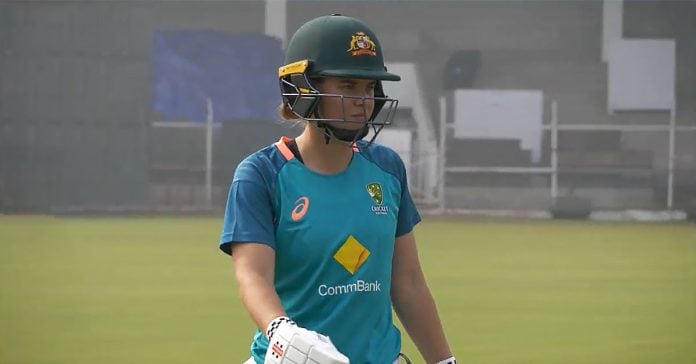
As rising talent Phoebe Litchfield approaches a return to fitness, Australia’s squad selectors must make a number of difficult choices. Due to an acute quad injury she picked up after a scorching 50 off 24 balls against South Africa on June 13, the 22-year-old left-hander has missed the previous three group matches. Coach Shelley Nitschke characterizes her possible availability as a welcome headache for the club management.
Before the game against Pakistan, the top hitter underwent a demanding fitness test on the Headingley outfield, where she completed a running exercise and a strong net stint. Nitschke is still very certain that Litchfield will be prepared for this Sunday’s eagerly awaited T20 World Cup match against India at Lord’s.
Rearrangements in the Batting Order if Phoebe Litchfield returns
The Australian top order will be altered with Litchfield’s anticipated return to the number three spot. Ellyse Perry, a seasoned all-rounder, filled the void with scores of 19 not out, one, and 71. In order to make room for the young player, Perry is expected to drop back to number four, which means someone from the current playing eleven will have to sit out.
“I think Pheebs is tracking really well and hopefully will be available for the India game,” Nitschke said, as quoted by cricket.com.au.
“And then, that’s going to be really tough call – Pheebs is likely to come back into that number three position, so then we’ve got some decisions to make on what the set-up looks like and how to structure up. But obviously someone has come out for her.”
The situation with Grace Harris makes batting choices even more difficult. She is a great candidate for selection because of her vast experience performing at Lord’s for the London Spirit in The Hundred. Although Harris only had one appearance in this tournament as Ashleigh Gardner’s injury substitute against Bangladesh, she has an excellent strike rate of 165 in English domestic T20 cricket.
The coaching staff must choose the makeup of their bowling unit in addition to the batting order. In recent games, Megan Schutt and 19-year-old Lucy Hamilton were among the different combinations that Australia used to rotate its pace resources. Despite without taking a wicket, Hamilton maintained an economical rate of 3.83 in her performances against Pakistan and the Netherlands.
Selectors will probably have to give up one of their specialty spinners if they choose to keep a conventional frontline quick like Schutt or Hamilton with all-rounders Perry, Annabel Sutherland, and Nicola Carey. In three of their four group games, Australia has used four slow bowlers, demonstrating their preference for a spin-heavy strategy.
Assessing the Spin Division
There are conflicting explanations for the final roster based on the spin bowlers’ performances. Thus far in the competition, Georgia Wareham and captain Sophie Molineux have excelled. With six wickets at an incredible average of 9.00, Molineux tops Australia’s wicket-taking rankings, while Wareham has five wickets at an economy rate of 3.80.
On the other hand, wickets have been more difficult to come by for off-spinner Ashleigh Gardner and leg spinner Alana King. Gardner has only taken one wicket at an average of 51, whereas King has got two at an average of 25. After training sessions at Lord’s on Friday and Wormsley on Saturday, team management will complete their tactical plan.
For more updates and news from around the cricket globe, check out CricBlog’s news hub.

