

Last Updated on 9 months ago by Charbel Coorey
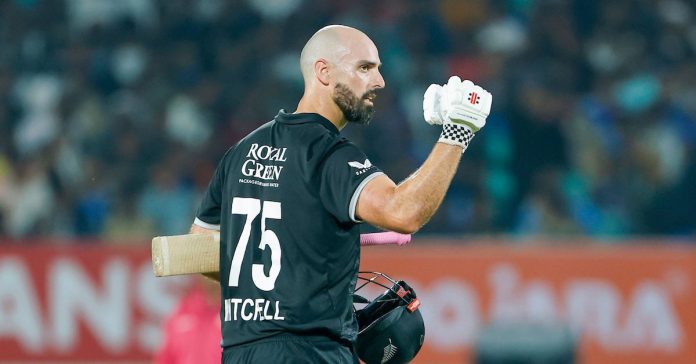
Twice in recent years, Daryl Mitchell has stood between New Zealand and glory against India: a defiant 134 in the 2023 World Cup semi-final, nearly dragging his side to an improbable chase; and an unbeaten 131 in Rajkot to level an ODI series. He now has over 2,500 ODI runs at an average of 56.73 and is widely regarded as one of the world’s best ODI batters. Rewind the clock, though, and you find a player who waited patiently in the shadows. From teenage years in Western Australia to a decade spent grinding in New Zealand’s domestic circuit, Mitchell’s career has been defined by patience and resilience.
Daryl is the son of John Mitchell, a figure of immense stature in global rugby. John Mitchell’s career — as a relentless loose forward for Waikato and a coach for the All Blacks, England, the USA, and various Super Rugby franchises — created a home environment shaped by the ruthless standards of elite professional sport. Daryl has frequently cited his father’s career as a primary source of his own mental resilience.
Daryl Mitchell’s Story: Early days in Australia has shaped his batting
The physical manifestation of this lineage is evident in Daryl’s nickname, “Moose”. Standing 6 ft 3 in with a broad, powerful frame, his athletic build resembles that of a rugby flanker more than a traditional cricketer. That physicality shows in his batting, built on a solid base and powerful forearms, much like a rugby player in contact.
When his father was coaching the Western Force in Perth, Mitchell spent five formative years in the Australian cricket system. He attended Hale School – a prestigious institution with a rich cricketing tradition – and played grade cricket under the leadership of Justin Langer for Scarborough Cricket Club. This period was instrumental in hardening Mitchell’s technique against pace and bounce. The WACA pitches, historically the fastest in the world, forced Mitchell to develop a robust backfoot game.
Daryl Mitchell represented Western Australia at the Under-19 and Under-23 levels and even trained at the Australian Centre of Excellence. This early exposure to cricket in Australia added a layer of steel to his character, though he has said that he “always” saw himself as a Kiwi despite the time spent there. When he returned to Hamilton in 2011 to join Northern Districts, he brought with him a hybrid cricketing identity: the humility of a Kiwi combined with the combative competitiveness of an Australian.
How Daryl Mitchell’s six-hitting ability caught attention
Mitchell was initially categorised as a utility allrounder – a player capable of batting in the lower order and bowling decent medium pace. He averaged 54.53 in his second season, hinting at his potential, but struggled to maintain that consistency over time. His name shot to fame in the 2018/19 Super Smash season, where he amassed 323 runs and, more importantly, hit 19 sixes — the most by any batter that season — earning him the “Super Smash Player of the Year” award. Soon after, his unbeaten 170 vs Canterbury also caught the eye, showing the world that the T20 basher also possessed the defensive technique required for red-ball cricket.
However, he remained a fringe player on the sidelines, often carrying drinks for the national team and featuring only when senior players were unavailable. Around this period, he also made a move from Northern Districts to Canterbury in 2020.
2021 T20 World Cup: Mitchell’s turning point
The most dramatic and unexpected pivot in Mitchell’s career came at the 2021 ICC T20 World Cup in the UAE. In a late tactical shift, Mitchell was pushed up to open the batting alongside Guptill — a position he had never occupied across his 116-match T20 career. He scored a crucial 49 off 35 against India, but the defining moment came in the semi-final.
Chasing 167 against England, Woakes removed Guptill and Williamson early. An 82-run fourth-wicket partnership followed between Conway and Mitchell, but the big man struggled to get going. When Conway was dismissed in the 14th over, Mitchell found himself on 36* off 31, with the pressure mounting as the required run rate crept close to 12.
Neesham teed off towards the end, bringing the equation down to 20 needed off the final 12 balls, leaving the weight of an entire nation on Daryl Mitchell’s shoulders. Mitchell backed his strengths. He sat deep in the crease, cleared his front leg, waited for the ball to arrive, and clobbered Woakes for two big sixes down the ground. In typical Daryl Mitchell fashion.
A year later, against the same team, Mitchell made history again. This time in a different format. He announced himself in Test cricket with a record-breaking series in England, smashing 538 runs in just three Tests at an average of 107.60, breaking Martin Donnelly’s 1949 record (462 runs) for the most runs by a New Zealander in a Test series in England. This series marked Mitchell’s transition from a “filling-in” all-rounder to a specialist middle-order batter of world-class pedigree.
Daryl Mitchell’s batting technique: The base of a strong game, especially in ODIs
The cornerstone of Mitchell’s batting, especially in white-ball cricket, is his vertical bat swing. He is extremely strong in the “V” down the ground, with notable power generated through his bottom hand. He also uses his reach brilliantly, which, combined with that strong bat swing, allows him to generate immense power even from lengths other batters might struggle against.
His reach makes him especially effective against spin, rare for a Kiwi batter. It allows him to get to the pitch of the ball and powerfully launch spinners down the ground for sixes. He can also score square of the wicket on both sides with sweeps and reverse sweeps, all of which makes it difficult for spinners to contain him or even set fields against him. He can also milk spinners effectively for singles. For this reason, he averages 67.4 against spin in ODI cricket.
ICC events seem to bring the best out of Daryl Mitchell. Much like in 2021, he was New Zealand’s standout performer at the 2023 ODI World Cup in India, scoring 552 runs and finishing as the tournament’s fifth-highest run-scorer. He smashed not one but two centuries against India, doing so against a red-hot Indian bowling unit when no other batter managed to score a hundred against them in the tournament.
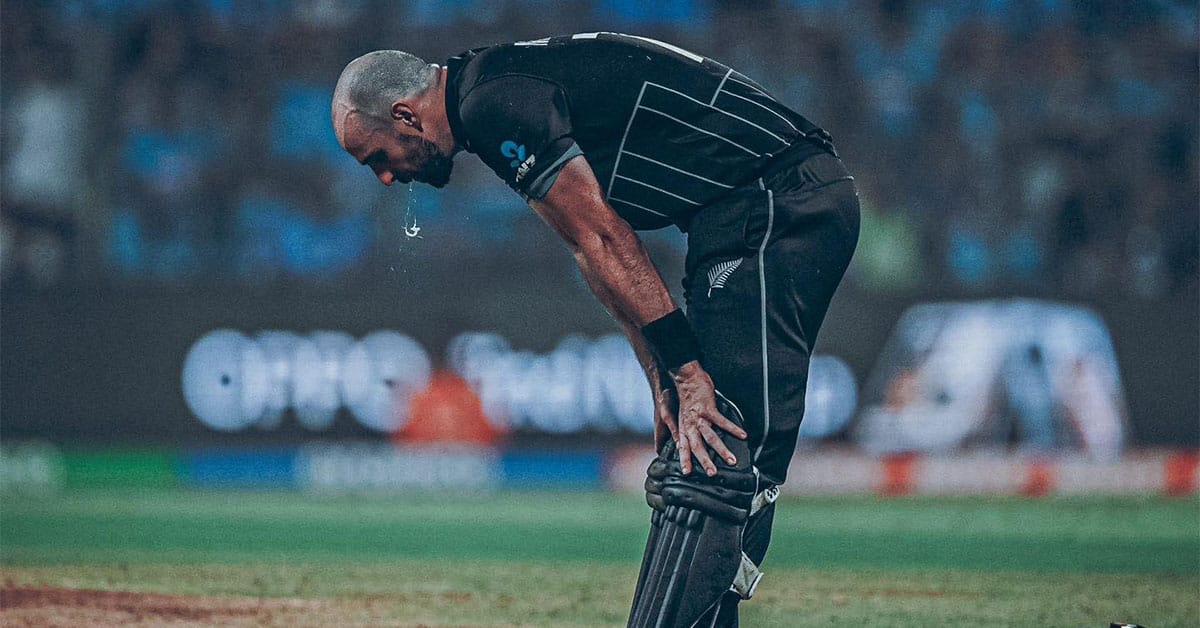
ODI cricket, in fact, has emerged as Daryl Mitchell’s best format. He even rose to the top of the ICC ODI batting rankings very recently – becoming the first Kiwi to do so since Glenn Turner in 1979 – and even now finds himself eerily close to the podium spot. As of now, with a 2,000-run cut-off, Mitchell’s ODI average is the second-best ever, just behind Virat Kohli. For any New Zealand player with a minimum of two innings, Mitchell’s ODI average in Asia (56.03) is the best ever.
In the 2020s, Daryl Mitchell has scored 2,256 ODI runs batting in the middle order (No. 4-7), the third-highest tally in the world, behind only Charith Asalanka and KL Rahul. He has no apparent weaknesses in this format and averages 45+ against every bowling type in his career so far.
There are few players in the world versatile enough to combine over 2,500 ODI runs at an average above 55, more than 2,000 Test runs at an average close to 45, and a T20 strike rate nearing 140 — all while remaining a useful option with the ball. Daryl Mitchell sits comfortably in that rare category.
Today, “Moose” doesn’t just fill a gap in the team sheet; he stands as a pillar of New Zealand’s team across formats one of the most complete players in the world.

