

Last Updated on 3 weeks ago by Charbel Coorey
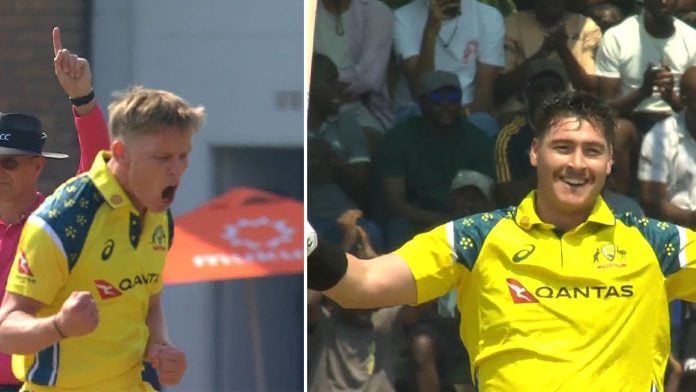
Career-best performances from Matt Renshaw and Nathan Ellis led Australia to a 59-run win in the first ODI against Zimbabwe in Harare. The duo played key roles with bat and ball respectively as Australia found themselves in tricky predicaments throughout the match.
Batting first after winning the toss, Australia always seemed to be one or two more wickets down than they would’ve liked at a particular stage. They lost their fourth by the 18th over, after which Renshaw produced a brilliant innings, with his tempo and scoring range the hallmarks of a maiden ODI ton.
In response, Zimbabwe, chasing 295, had some good moments. Brian Bennett and Innocent Kaia were looking solid on an easy-paced afternoon surface, putting on 44 together in just seven overs. Later, Craig Ervine and Sikandar Raza combined for a 98-run stand to leave Zimbabwe needing a very gettable 135 off the final 118 balls with six wickets in hand.
Both times it was Nathan Ellis who delivered. He dismissed Kaia and Bennett in the ninth over before getting the crucial wicket of Ervine in the 31st. From that point on, Australia picked up regular wickets to seal a comfortable victory.
ZIM vs AUS 1st ODI: Biggest talking points for Australia in run towards 2027 World Cup
Despite the win, there are some key questions for Australia to answer ahead of their World Cup title defence next year.
1. Australia’s finishing conundrum: Who should bat at seven?
The squad on paper looks short of power-hitters after Glenn Maxwell’s retirement. Oliver Peake was listed to bat at seven, and while he played a key role in ensuring the visitors reached the death overs with wickets in hand, Australia’s finishing left plenty to be desired.
Australia scored just 66 runs in the final ten overs and hit one boundary in the last seven overs. Such returns can see the Aussies come unstuck, making this arguably the biggest area for improvement.
One option is Tim David for future ODIs. While he has limited List A experience of just 20 matches, he has smashed 790 runs at an average of 60.76 and strike rate of 120.06 in 50-over cricket.
However, for David – or any number seven – to work, Australia must buck the trend of losing early wickets. It was a common theme in Pakistan and Bangladesh earlier this year, meaning the launch period had to come later to reduce the risk of getting bowled out early.
2. Who does Cameron Green come back in for?
Cameron Green missed the first ODI in Harare due to shoulder soreness. If fit, he surely makes the XI given his all-round role and the potential the team management see in him.
Who then misses out? Before the series opener, CricBlog put the question forward as to whether there is room for both Josh Inglis and Alex Carey. If both play, Oliver Peake would be the one to miss out, but that means Australia miss an opportunity to give the 20-year-old very valuable experience.
Another option is moving Peake higher up the order and batting Green lower down. Green has shown promise in T20 cricket in recent years, although he’s done his best work higher up the order in white-ball internationals.
Also, on Tuesday’s evidence, Renshaw deserves to be in the top five. Questions, questions, questions.
3. Does Nathan Ellis make Australia’s first-choice World Cup XI?
Ellis was outstanding on Tuesday, expertly varying his pace as he often does. A key difference, however, is his ability to now cross over 140km/h for his quicker deliveries. The stark changes in pace despite no obvious difference in arm speed is a huge asset for Australia.
But, does Ellis make Australia’s first choice XI when Pat Cummins, Mitchell Starc and Josh Hazlewood are available? There is a strong case that he does given his defensive bowling skills and ability to keep opponents on their toes.
4. Australia need more from Adam Zampa
In six ODIs this year, Zampa has taken three wickets at an average of 86.7 and strike rate of 107.7. This includes spin-friendly conditions in Pakistan.
Zampa’s economy rate of 4.83 is serviceable, but Australia need their legspinner to strike more in the all-important middle overs. This, in turn, will reduce pressure on the death bowlers.
5. Travis Head’s chop on problem
Travis Head has chopped on for the fourth time in a row. He was bowled three times in the recent Test series against Bangladesh, and inside-edged a Brian Evans delivery onto his stumps in Harare.
This is an issue Head must sort out quickly with so many big assignments on the horizon. The bat angle is neither fully horizontal or vertical, leaving him susceptible to deliveries coming back into him after pitching outside offstump. Teams will continue to aim to exploit this, so there needs to be an answer.
There have been suggestions on social media that moving Head down the order in ODIs could be the answer. However, he has been outstanding as an ODI opener since the start of 2022, scoring 1,738 runs at an average of 52.7 and strike rate of 121.1, including a title-winning innings in the 2023 World Cup Final.
The second ODI between Zimbabwe and Australia will take place on Friday September 18 at the same venue.

