

Last Updated on 1 year ago by Charbel Coorey
Cricket News: Can India bounce back after such a defeat against Pakistan? | Looking at India’s defeat against Pakistan in the T20 World Cup
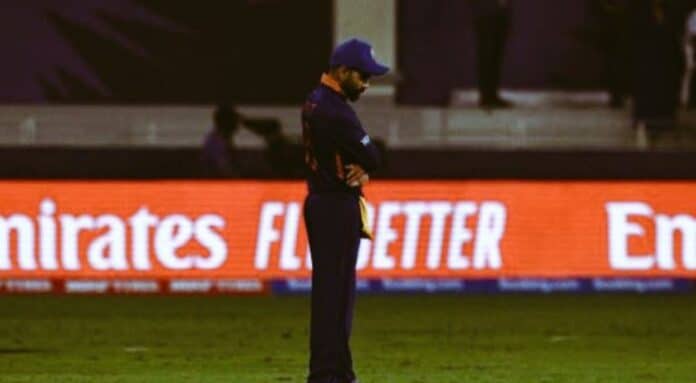
The World T20 2021 started on the strikingly disappointing note for India as the Virat Kohli-led side succumbed to a defeat against arch-rivals Pakistan in the opening game.
For India, a loss against any other team is merely a cricketing setback. But against Pakistan it brings along several untoward consequences considering the troubled history that the two countries share.
It becomes much bigger than merely a game of cricket. It becomes a clash of civilizations that share a combined history, thus adjoining a much greater significance to the entire setup.
Fans eagerly wait for the encounter and the fact that it takes place only in ICC tournaments means that the stakes are obviously always higher than ever.
In such circumstances, for the Indian team to be defeated as comprehensively as they were is bound to evoke some edging reactions from across the country.
As it is, the social media has given a voice to the voiceless. Someone who would have thought twice before passing an arguably harsh comment against any personality now goes around tweeting the same in abundance, hiding behind the anonymity offered by such networking websites.
Nevertheless, regardless of the humungous importance of this game, at the end of the day result of the match is eventually determined by how a team carries out its responsibilities on the field.
India was outplayed against Pakistan
Sure, there’s that point over holding your nerve through delicate situations but the Indian team was outplayed rather than outmaneuvered in key moments.
Pakistan held control over the proceedings right from the offset. The bowling plans were there in place, with Shaheen Afridi executing them to perfection.
The opening burst that culminated in the departure of the Indian openers was followed with an equally disciplined approach in the middle-overs.
Hassan Ali did not have the best of days on the field, but he produced one particular moment of brilliance, that tinge of outswing in the powerplay that Suryakumar Yadav couldn’t pick and hence had to walk back to the pavilion too.
The spin twins of Shadab Khan and Imad Wasim were consistent in their efforts too, hardly giving the Indian batsmen a phase to get hold of the proceedings and walk away with the game.
For instance, Rishabh Pant looked to have set a platform to accelerate as he hit a couple of maximums of Shadab. The leg-spinner ended up dismissing him the very same over. Hardik Pandya looked set to explode and help India attain around 20 runs above the par score in the final over but he didn’t last for the entire length of the innings either.
The only reason India stayed throughout the game was because of the genius of Virat Kohli, who not only weathered the early storm but also anchored the innings through the middle overs. Unfortunately, even he departed during a crunch moment when India could have really imploded the innings and gotten themselves a good total.
India have questions to answer with the ball
The more disappointing aspect was the bowling from India, though. There was perhaps ample time to observe the Pakistani bowlers and devise what works best on the pitch. The Pakistani pacers were excellent in varying the pace of the ball regularly towards the end of the innings. But they kept the speed high in the early part of the innings to extract some movement off the surface.
However, the Indian pacers, namely Bhuvneshwar Kumar bowled at a very minimal pace right from the beginning.
This obstructed them from producing any incisiveness to trouble the Pakistani openers. Mohammed Shami’s outing was dismal mainly because he seemed to be bowling at the stumps throughout his spells, though it had appeared early on that the approach wasn’t delivering the desired outcomes.
Maybe India could have taken a more proactive approach in the beginning, allowing Jasprit Bumrah to bowl his initial couple of overs early on and repeating the same with Varun Chakravarthy as well. Bhuvneshwar too could have arguably enticed the Pakistani batsmen to play their drives more. Or maybe the dew along with the moisture on the track prevented them from going after the aforementioned plans, one will never know.
What one does know is that the defeat of the team that day was driven mainly by on-field factors, which is slated to happen once in a while every time in competitive sports. The fact that it occurred against arch-rivals whom India had never lost against in the World Cup is surely devastating, but such is sport and there is a necessity to move ahead from the same to effectively counter the coming challenges.
“If you are proud of the fact that we won 11-0 then there is another reality that we will lose at some point in time. Maybe we will lose today, maybe after 20 years or maybe after 50 years. But you know this can’t happen that you’ll always keep winning).”
These were the words of MS Dhoni after he captained the Indian team to a victory against Pakistan in the 2016 World T20 at the Eden Gardens in Kolkata.
If a skipper who led India to seven consecutive victories against Pakistan in World Cups can maintain this humility and such a realistic outlook, then why can we fans not try and imbibe some of these same attributes?
Of course, fans are driven by passion and passion is more or less unhindered, stimulated by emotions and blind to rationality at times. But, the art of keeping ones emotions in check to critically examine the game should not be lost in the meanwhile.
Success in top-tier sports requires one to detach themselves from the results and constantly improve upon their drawbacks by keeping a composed head at all times. The Indian team will surely do that and better results are surely on the way in the coming games.
Written by Tarkesh Jha. Follow Tarkesh on Twitter

