Home Blog Page 47

Adelaide Oval ODI records, recent highest scores & pace vs. spin stats comparison

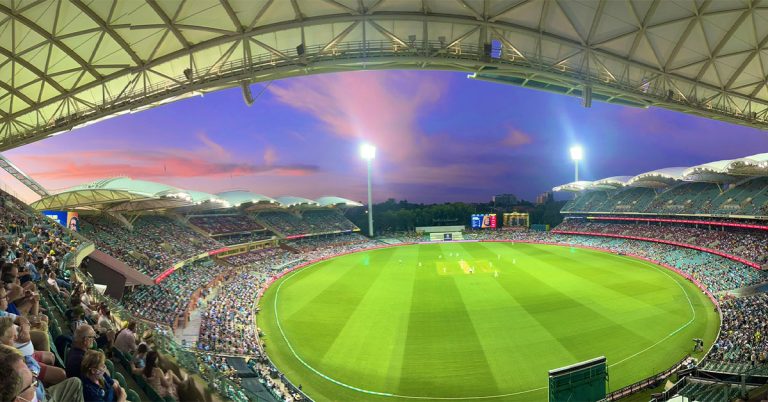
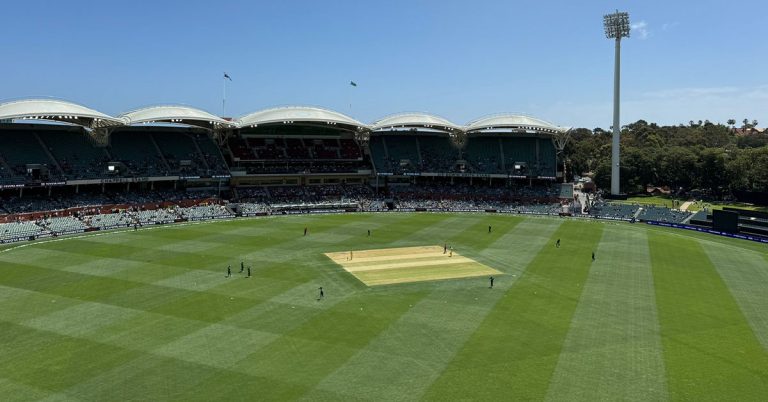
Australia and India will square off at the Adelaide Oval for the second ODI of their bilateral series on October 23. The home side secured a comfortable seven-wicket win in the series opener at Perth, and will be looking to seal the series on Thursday.

Adelaide Oval ODI records: Chasing the key to victory again?

Adelaide Oval ODI Results – Last 10 matches

  • November 2024: Pakistan (169/1) beat Australia (163) by nine wickets.
  • November 2022: Australia (291/4) beat England (287/9) by six wickets.
  • January 2019: India (299/4) beat Australia (298/9) by six wickets.
  • November 2018: Australia (231) beat South Africa (224/9) by seven runs.
  • January 2018: Australia (197/7) beat England (196) by three wickets.
  • January 2017: Australia (369/7) beat Pakistan (312) by 57 runs
  • March 2015: Australia (216/4) beat Pakistan (213) by six wickets.
  • March 2015: Pakistan (241/3) beat Ireland (237) by seven wickets.
  • March 2015: Bangladesh (275/7) beat England (260) by 15 runs.
  • February 2015: India (300/7) beat Pakistan (224) by 76 runs.

This ground has a tendency to be perceived as a batting-friendly track, but the numbers paint a different picture. Of the 94 ODIs played, teams have averaged a first innings score of a modest 225. In the last 10 ODIs, the average first innings score rises to 256.9, but the bowlers still have a say.

The highest total recorded at Adelaide in ODIs is the 369 scored by Australia against Pakistan in late 2016. David Warner and Travis Head smashed 179 and 128 respectively.

Pace vs spin records: Fast bowlers rule the roost

Like most Australian pitches, pacers have found their groove at Adelaide more than the spinners. Brett Lee and Glenn McGrath are the highest wicket takers in ODIs on the ground, with both of them grabbing 23 and 21 wickets respectively. Malcom Marshall and EJ Chatfield are amongst the top in the overseas list, with 15 and 13 scalps to their respective names. Speaking of the slower bowlers, it’s the leg-spinners who have extracted the most purchase off the surface, with Shane Warne and Brad Hogg sharing 28 wickets between them.

In the last 10 ODIs at Adelaide, the fast bowlers are totally dominant compared to spinners. Pat Cummins (10), Mitchell Starc (7), and Josh Hazlewood (6) have secured the highest count of dismissals. Haris Rauf and Bhuvneshwar Kumar have taken five and four wickets respectively, whereas Adam Zampa also has five wickets to his name.

Australia will bank on the seasoned duo of Starc and Hazlewood to come out all guns blazing yet again, especially after their prolific outing at Perth and their aforementioned record at Adelaide.

Pace vs. spin comparison in last 10 ODIs at the Adelaide Oval

PaceSpin
122 wickets17 wickets
Average: 29.07Average: 81.59
Economy: 5.32Economy: 5.69
Four-wicket hauls: 7Four-wicket hauls: 0
Five-wicket hauls: 2Five-wicket hauls: 0

Key records in ODIs at the Adelaide Oval:

  • 94 ODI matches have been played at this venue.
  • 49 matches have been won by teams batting first, while 43 matches have been won by teams bowling first.
  • The average first innings score is 225, while the average second innings score stands at 197.
  • The highest total recorded is 369/7 in 50 overs, scored by Australia against Pakistan.
  • The lowest total recorded is 70 all out in 26.3 overs, scored by Australia against New Zealand.
  • The highest successful chase at this ground is 303/9 in 49.4 overs, achieved by Sri Lanka against England.
  • The lowest total successfully defended is 140 all out in 49 overs, by Pakistan against the West Indies.
  • Virat Kohli averages 61.00 in four ODIs on this ground, with two centuries.

All statistics in this article have been checked and verified via ESPNcricinfo and Cricmetric.
Australia possible 11 for 2nd ODI against India 2025

A new-look Australia took a 1-0 lead in the ODI series against India, courtesy of a seven-wicket victory at Perth. The experienced duo of Mitchell Starc and Josh Hazlewood led the way with inspired new-ball bowling, before captain Mitchell Marsh continued his magnificent run of form to see the hosts home.

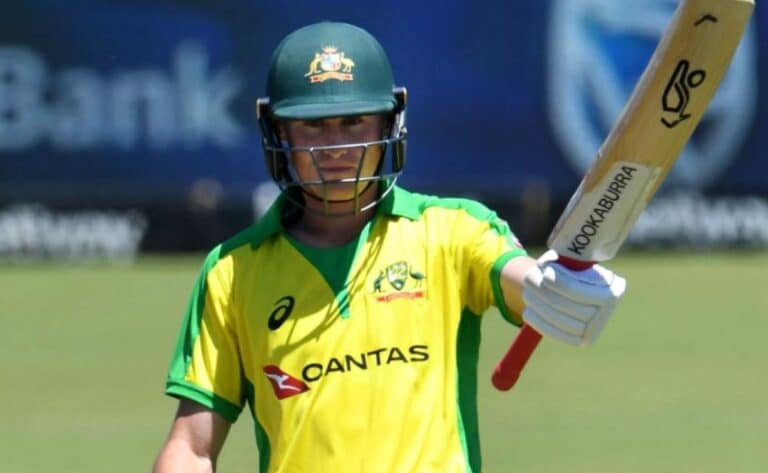
Australia are expected to welcome back some familiar faces. Marnus Labuschagne is available after a magnificent start to the domestic season, as is Alex Carey who missed the first ODI due to Sheffield Shield commitments.

Rain is forecast on Tuesday and Wednesday in Adelaide. This could make for tricky batting conditions. Overcast conditions are expected on Thursday for the second ODI, which may prompt the team who wins the toss to bowl first.

Australia predicted 11 for the 2nd ODI against India at the Adelaide Oval

1. Travis Head, 2. Mitchell Marsh (c), 3. Marnus Labuschagne, 4. Matt Renshaw, 5. Alex Carey (wk), 6. Mitch Owen, 7. Cooper Connolly, 8. Mitchell Starc, 9. Nathan Ellis, 10. Josh Hazlewood, 11. Adam Zampa

Josh Inglis will also miss the second ODI due to a calf injury, but will return to the squad for the Sydney match. Alex Carey could slot into the XI in place of Josh Philippe, although the latter impressed with gloves and bat in the rain-affected series opener.

Legspinner Adam Zampa is set to return, according to cricket.com.au. The aformentioned platform also confirmed Matt Kuhnemann will head home and return to the Australian squad for the T20I series.

With regards to the remainder of the attack, Australia could look to play both Mitchell Starc and Josh Hazlewood given the lengthy turnaround between the first and second ODIs. The big guns may be rested for the third ODI at the SCG, which begins less than 48 hours after the second match.

From a batting point of view, expect Marnus Labuschagne to slot in at number three in place of Matt Short. Labuschagne was originally dropped from the squad after a lean series against South Africa earlier this year, where he made scores of 1 and 1.

ALSO READ: Why is Cameron Green not playing in the Australia-India ODI series?

However, Labuschagne has been in irresistible form since. He has struck two centuries for Queensland in three One Day Cup matches, namely 130 off 118 balls against Victoria and 105 off 91 balls against Tasmania. The 31-year-old has been proactive at the crease, and will be looking to continue his good form if he’s recalled to the Australian team.

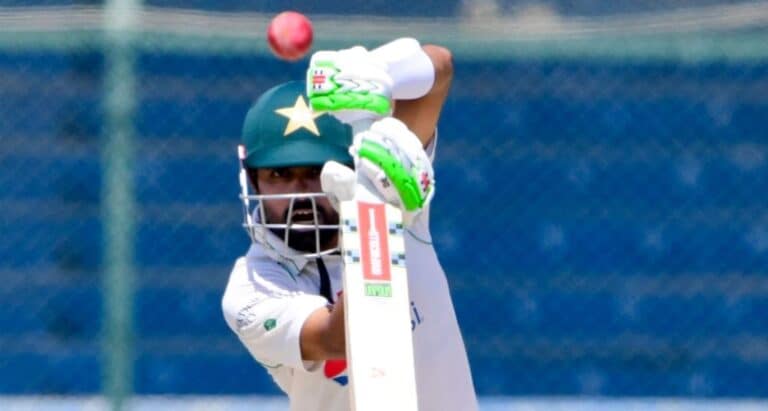
When is the last time Babar Azam scored a Test century?

Babar Azam’s wait for a tenth Test century continued after he was dismissed for 16 AND 50 in second Test against South Africa. Pakistan’s number four was brilliantly caught by Tony de Zorzi at silly point off the bowling off Keshav Maharaj in the first innings, much to the shock of the fans at the Rawalpindi Cricket Stadium.

In the second innings, Babar played quite nicely, but his innings was cut short early on day four, trapped LBW by Simon Harmer.

Babar Azam’s last Test century stretches back nearly three years

Babar Azam’s last Test century was a masterful 161 against New Zealand at Karachi in December 2022, some 29 innings ago. In that same year, Babar also made hundreds against Australia (196 at Karachi), Sri Lanka (119 at Galle) and England (136 at Rawalpindi).

By the end of 2022, Babar had 3,645 Test runs at an average of 49.3. His average now sits at 42.38.

Babar Azam in Tests until end of 2022Babar Azam in Tests since his last century
83 innings29 innings
3,645 runs721 runs
Average: 49.3Average: 24.86
26 fifties4 fifties
9 hundreds0 hundreds

The classy batsman even found himself dropped during last year’s Test series against England following a lean run of form. According to ESPNcricinfo, this decision was “recommended by the newly formed selection committee, which met in Lahore within hours of the loss in the first Test [by an innings against England] on Friday.”

After the two Tests against South Africa, Pakistan’s next Test assignment will be two Tests away in Bangladesh in March and April 2026. They will also play the West Indies (two Tests) and England (three Tests) away from home in mid-2026. Their next home fixtures in the World Test Championship are Sri Lanka (two Tests) in November 2026 and New Zealand (two Tests) in March 2027.

IND-W vs ENG-W Twitter Reactions: Fans criticise Indian women’s team after lacklustre collapse against England in ODI World Cup

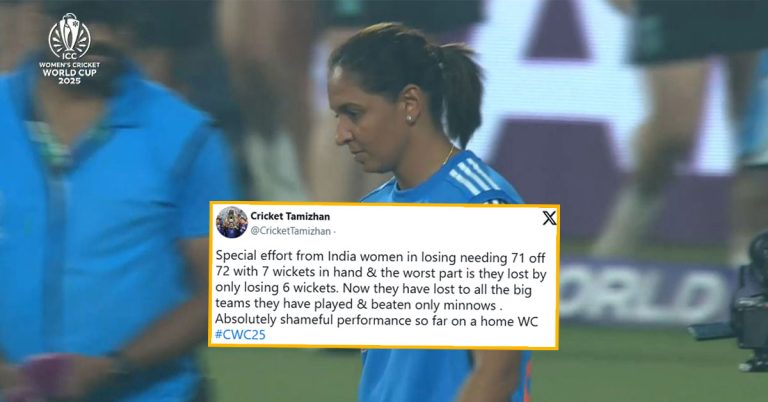
The India Women’s team suffered another heartbreaking loss in a nail-biter against England Women in the ICC Women’s Cricket World Cup 2025, leaving fans visibly frustrated on social media. Despite being in control for most of the chase, the hosts fell short by just four runs in Indore on Sunday (October 19), a defeat that now leaves their semi-final hopes hanging by a thread.

England, opting to bat first, posted a formidable 288/8 in 50 overs, powered by captain Heather Knight’s brilliant 109 off 91 balls, laced with 15 boundaries and a six. In reply, India looked well on course for a record chase with Smriti Mandhana (88), skipper Harmanpreet Kaur (70), and Deepti Sharma (50) guiding the innings with authority.

At one stage, India needed just 56 runs off the final nine overs with seven wickets in hand on a batting-friendly pitch, but a late collapse saw them stutter to 284/6 at the end of their 50 overs. The narrow defeat has placed India in a precarious position, a must-win scenario against New Zealand Women in their next league game to stay alive in the tournament.

This marks India’s third straight close loss after strong starts, following similar heartbreaks against South Africa and Australia. Fans took to social media to vent their disappointment, criticising the team for losing composure in crunch moments despite getting everything they ever demanded, home conditions, crowd support, and form at the start of the tournament. 

Reactions IND-W vs ENG-W 2025 Women’s World Cup thriller: How did India lose that?

Earlier, the Women in Blue had lost to Australia in Vizag, with the Southern Stars completing the highest-ever chase in ODI history, thanks to them scaling the peak of 331 runs in the second innings. The Harmanpreet Kaur-led side then also lost to South Africa, and critics have raised concerns regarding their poor performances against strong opponents in this multi-nation tournament. 

India face New Zealand and Bangladesh in their final two group games. Failure to reach the semi-finals in a home World Cup would be a huge disappointment.

Adelaide Oval weather forecast for 2nd AUS vs IND ODI

On the back of a pace-bowling onslaught and Mitchell Marsh’s solid unbeaten 46, Australia took a 1-0 lead in the three-match ODI series against India. However, it was a largely frustrating day for players and spectators, with persistent showers regularly halting proceedings at Perth’s Optus Stadium.

The series moves to Adelaide for the second ODI on Thursday October 23. There is some rain around in the city this week, so here is a look at the forecast for the match.

Adelaide Oval weather forecast: Rain should clear in time for 2nd AUS vs IND ODI on Thursday

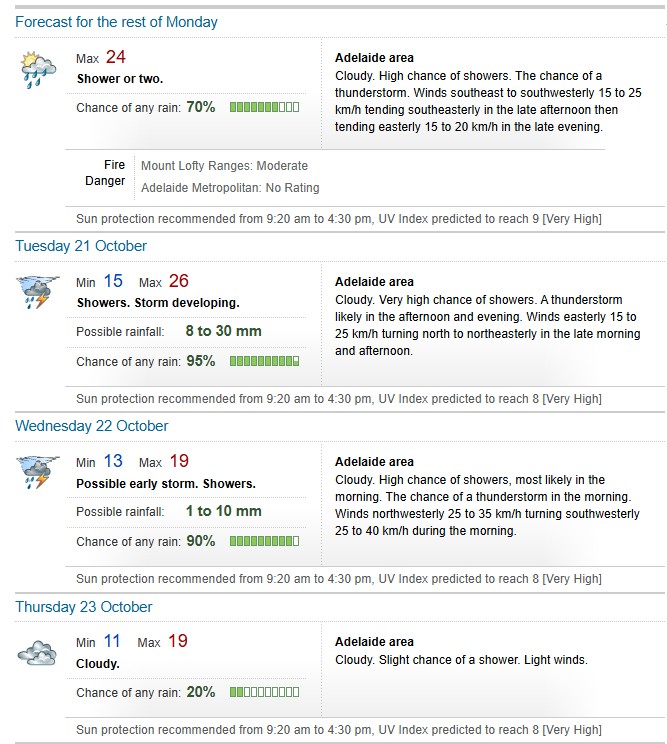
There are plenty of showers forecast in Adelaide this week, with chances of thunderstorms and up to 30mm of rain on Tuesday. There are also showers forecast on Wednesday.

Thursday looks more promising. According to the Bureau of Meteorology, the forecast is for cloudy conditions and a 20% chance of rain. It will be a cool day with a top of 19 degrees, which may tempt the captain who wins the toss to bowl.

Rain is forecast in Adelaide this week, but the forecast looks more promising for the 2nd ODI between Australia and India on Thursday.
Adelaide weather forecast for 20 to 23 October 2025 according to Bureau of Meteorology.

AccuWeather paints an even more promising picture. The platform forecasts clouds and sunshine with just a 2% chance of precipitation. Going by the predictions, there should be a full, uninterruped match.

Adelaide weather forecast 2nd AUS vs IND according to AccuWeather.

Adelaide Oval played host to a Sheffield Shield match between South Australia and Queensland that ended on Saturday (October 18). The Queensland bowlers found assistance on day one, before it settled down into a slower, lower track as the match went on. Legspinner Mitchell Swepson won man of the match for his 10 wickets.

Rain in the leadup to the second Australia-India ODI can affect pitch preparation. The surface will spend plenty of time under the covers, and both teams may prefer making first use of any moisture in the pitch. Australia opted to bowl first in Perth and made inroads into the Indian top order on a surface that had pace and movement.

Optus Stadium Perth ODI records, highest scores & pace vs. spin stats comparison

Australia and India will meet in an ODI for the first time at Perth’s Optus Stadium. The hosts will be hoping its fourth-time lucky in 50-over cricket at this venue, with defeats in all their previous outings.

Optus Stadium Perth ODI records: Pace to dominate again?

Results in ODIs at Optus Stadium Perth: Three losses for Australia

  • January 2018: England (259) beat Australia (247) by 12 runs.
  • November 2018: South Africa (153/4) beat Australia (152) by six wickets.
  • November 2024: Pakistan (143/2) beat Australia (140) by eight wickets.

Bowlers have enjoyed proceedings in ODIs on this ground. The average first innings score is just 184, with Australia bundled out for 140 less than a year ago against Pakistan. The Pakistani fast bowlers were far too good that day, as Shaheen Shah Afridi (3/32), Naseem Shah (3/54), Mohammad Hasnain (1/24) and Haris Rauf (2/24) ensured there was no need for a fifth bowler.

Pace vs. spin records: Fast bowlers pick the bulk of the wickets

Fast bowlers have thrived on the pacy, bouncy Optus Stadium track. The quicks have picked up 35 wickets in the three ODIs to date at an average of 23.82 and economy of 4.67. Spinners have taken just seven scalps at an average of 32.57 and economy of 5.20.

PaceSpin
35 wickets7 wickets
Average: 23.82Average: 32.57
Economy: 4.67Economy: 5.20

The Australia-India ODI will feature seasoned fast bowlers. Josh Hazlewood and Mitchell Starc are key for the hosts, while the likes of Harshit Rana and Mohammed Siraj will be looking to reopen Australia’s Optus Stadium wounds.

Other key records at Optus Stadium Perth:

  • Highest team score: 259 by England (batting first) vs. Australia in January 2018.
  • Lowest team score: 140 by Australia (batting first) vs. Pakistan in November 2024.
  • Chasing teams have won two of the three ODIs at Optus Stadium. There is a chance of afternoon showers in the Australia-India ODI.
  • Best bowling figures: 5/35 by Tom Curran vs. Australia, 2018.
  • Highest individual score: 87 (99) by Marcus Stoinis vs. England, 2018.

List of richest cricket boards in the world 2025: What is the BCCI worth?

The richest cricket board in the world is unsurprisingly the Board of Control for Cricket in India (BCCI). The BCCI’s net worth is a staggering INR 18,460 crore (approximately US$2.11 billion), which is around 28 times more than the next richest board, according to Times of India.

Cricket Australia and England Cricket Board round out the top three. Both boards value Test cricket dearly but have been exploring ways to boost revenue further via T20 cricket.

Top 10 richest cricket boards in the world 2025

BoardValue
BCCIApprox. US$2.10 billion
Cricket AustraliaApprox. US$71 million
England Cricket BoardApprox. US$55.94 million
Pakistan Cricket BoardApprox. US$52.07 million
Bangladesh Cricket BoardApprox. US$48.32 million
Cricket South AfricaApprox. US$44.57 million
Zimbabwe CricketApprox. US$36.04 million
Sri Lanka CricketApprox. US$18.87 million
Cricket West IndiesApprox. US$14.21 million
New Zealand CricketApprox. US$8.53 million

1. BCCI: INR 18,460 crore (approx. US$2.10 billion)

Cricket is like a religion in India, which drives the BCCI’s growth. The Indian Premier League (IPL) generates huge revenue, with one of the world’s richest broadcast deals and significant ad revenue each season. According to abc.net.au, the 2025 edition was projected to generate around $800 million ad revenue alone.

Also, the BCCI landed a new sponsorship deal with Apollo Tyres, replacing Dream11 following the introduction of the 2025 Online Gaming Bill. The deal is worth a huge INR 579 crore (approximately US$66 million) according to cricexec, which runs through to March 2028.

The BCCI also receives about 38% of the ICC’s annual distribution model.

2. Cricket Australia (CA): INR 628 crore (approx. US$71 million)

Cricket Australia (CA) is the second-richest board with a net worth of approximately US$74 million. Broadcasting, ICC revenue, sponsorships and the BBL are its main revenue drivers. CA are exploring BBL privatisation to further drive revenue, but face key questions around how their summer would look and maintaining the league’s identity.

3. England Cricket Board (ECB): INR 492 crore (approx. US$55.94 million)

The ECB comes in third. Privatisation of The Hundred is a major revenue generator for the board, along with ICC revenue and strong attendances for international and domestic matches around the country.

4. Pakistan Cricket Board (PCB): INR 458 crore (approx. US$52.07 million)

PCB comes in fourth. Pakistan has a big population of approximately 251.3 million (as of 2024) and is a nation passionate about cricket. The Pakistan Super League (PSL) is a major revenue generator for the PCB, as is their ICC revenue share of 5.75% which equates to around $34.51 million annually.

Also, hosting major tournaments since international cricket restarted in the country is a big boost. The 2025 Champions Trophy yielded a profit of US$10 million for the PCB. “All expenses for the tournament were covered by the ICC,” said PCB spokesperson Aamir Mir, as quoted by Times of India. “Additionally, after the audit, we expect to receive another Rs 3 billion from the ICC.”

5. Bangladesh Cricket Board (BCB): INR 425 crore (approx. US$48.32 million)

The Bangladesh Premier League (BPL) has its issues, but despite that, Bangladesh rank fifth in the list of richest cricket boards. The tournament attracts sponsors and cricket is the most popular sport in Bangladesh, which helps drive the BCB’s revenue.

6. Cricket South Africa (CSA): INR 392 crore (approx. US$44.57 million)

CSA is experiencing more financial stability since the launch of the SA20. The T20 league has seen IPL franchise owners invest heavily, generating huge viewership not only in South Africa, but in the subcontinent as well.

In 2022, Graeme Smith said this T20 league is crucial to CSA’s survival. “It was absolutely crucial [to have a T20 league of our own],” said the former Proteas captain. “We can’t rely on everybody else for the financial gain. I think that’s a very risky place to be in world cricket currently.”

7. Zimbabwe Cricket (ZC): INR 317 crore (approx. US$36.04 million)

ZC’s place in seventh may come as a surprise given the financial and political challenges it has faced over the years. However, Zimbabwe playing big teams in recent years, and holding onto their sponsorship deals, has ensured a solid position financially.

8. Sri Lanka Cricket (SLC): INR 166 crore (approx. US$18.87 million)

The Lanka Premier League (LPL) is important for Sri Lanka, as are their broadcast deals and ICC revenue share. The more Sri Lanka play higher-ranked teams, the better it is as such series attract more eyeballs.

9. Cricket West Indies (CWI): INR 125 crore (approx. US$14.21 million)

It is no secret that the West Indies face a huge challenge to retain talent with T20 leagues around the world. Players earn lifechanging amounts in these leagues. They earn a fraction of those amounts to play international cricket.

The key revenue source for CWI is its Caribbean Premier League (CPL), which has also seen investment from IPL franchises in recent years.

10. New Zealand Cricket (NZC): INR 75 crore (approx. US$8.53 million)

NZC ranks tenth with their small population making things tricky from a revenue perspective. Also, T20 leagues are a very attractive proposition for a number of the players, including the likes of Kane Williamson who are on casual contracts.

However, the Black Caps continue to do well at international level, with their consistent performances helping them land broadcast and sponsorship deals.

Why is Cameron Green out of the ODI series against India?

Cameron Green’s return to bowling has hit a setback, with the Australian all-rounder ruled out of the upcoming ODI series against India due to side soreness. Cricket Australia confirmed that the injury is low grade, and his omission is precautionary, with Green expected to resume playing for Western Australia in their next Sheffield Shield match starting October 28.

Cricket Australia said Green felt discomfort during training earlier this week. “Green will complete a short rehabilitation phase and is on track to return for round three of the Sheffield Shield,” the board stated. The setback is unrelated to the spinal surgery he underwent last year, where doctors fused his L4 vertebrae.

Marnus Labuschagne replaces Cameron Green in ODI squad against India

The decision to rest Green comes with the Ashes on the horizon, as Australia’s management remains cautious about his recovery. The 26-year-old’s return as a fully fit all-rounder is considered vital to the team’s Test plans this summer.

In Green’s absence, Marnus Labuschagne has been drafted into the ODI squad. The Queensland batter, who was initially left out after a poor run in South Africa, earned a recall on the back of red-hot domestic form, including his fourth century of the season, a 159-run knock against South Australia in the ongoing Shield match.

Green had bowled his first competitive overs in nearly a year during Western Australia’s Shield opener against New South Wales, taking 1 for 13 from four overs. The right-hander had skipped the recent T20 series in New Zealand and was also left out of the upcoming T20Is against India to prioritise red-ball cricket before the Ashes.

Australia’s squad for the India ODIs has seen multiple changes, as wicketkeeper Josh Philippe replaces the injured Josh Inglis, while spinner Matthew Kuhnemann comes in for Adam Zampa, who is unavailable due to family reasons.

With Green out, Matthew Renshaw could slot in at No. 4, a position where he averages 50 at a strike rate above 100 in domestic one-day cricket.

ALSO READ: Australia’s possible XI for the first ODI against India in Perth

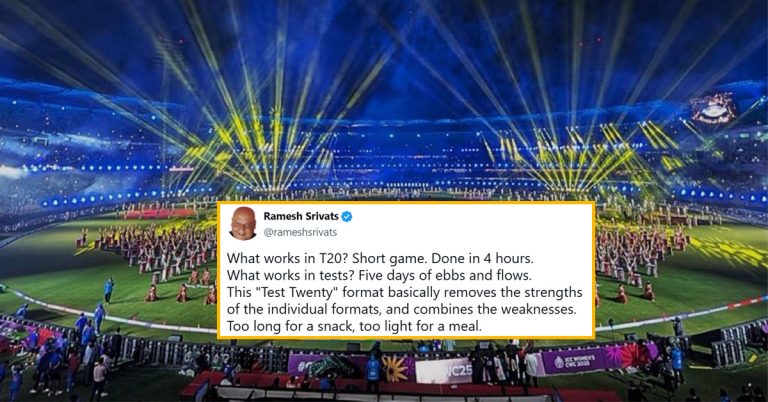
“Too long for a snack, too light for a meal” – Twitter Reactions to new Test Twenty format

Test Twenty, set to be cricket’s newest format, has divided opinion on social media. The format fuses Test and T20 cricket, with four innings of 20 overs to be played out with a red ball like a Test match.

Some of the rules of Test Twenty include:

  • Powerplay of four overs.
  • Teams can enforce the follow on with a first innings lead of 75 or more.
  • A maximum of five bowlers can bowl a maximum of eight overs across the entire match.

This format is expected to launch in January 2026 and is targeted at young cricketers, namely 13 to 19 year olds who can register at https://app.testtwenty.com/register. The first season will be held in India with three Indian city-based teams and three international teams, namely from Dubai, London and United States.

Indian sports entrepreneur Gaurav Bahirvani is the brainchild of Test Twenty. AB De Villiers, Clive Lloyd, Matthew Hayden and Harbhajan Singh part of the Advisory board. “When I was a boy in Pretoria, I hit a ball against a wall for hours hoping someone would notice. Back then, there was no global stage for young cricketers,” said AB de Villiers in a video posted on X (formerly Twitter).

“Today, that changes. The junior Test Twenty Championship is here. The world’s biggest youth scouting platform for 13 to 19 year olds. A brand new format, a brand new tournament,” he said.

Reactions to Test Twenty format: Does this idea have merit?

Opinions were split on the Test Twenty idea. Some fans enjoy the idea, while others question its role in developing talent.

“This “Test Twenty” format basically removes the strengths of the individual formats, and combines the weaknesses. Too long for a snack, too light for a meal,” wrote one fan on X (formerly Twitter).

“Prediction: only T20s and Test Twenty will live, Test Cricket and ODI will die. Because this is the natural evolution. At its core, what makes Test Cricket interesting and what’s keeping it alive is the 4 innings format,” wrote another.

Here are some of the reactions.

Opinion: The XI Australia should go with for the first Ashes Test

A year ago, questions were rife about the possible Australia XI for the Border-Gavaskar Trophy against India. Who opens? Who bats at six? Should the Aussies play who they perceive to be ‘the best six batters in the country’ even if it means players are out of position?

Fast forward 365 days and Australia face similar questions despite winning all three bilateral Test assignments since. Who partners Usman Khawaja is a hot topic of debate as many question if the 38-year-old should even play. Whether Australia can fit two all-rounders is another talking point, which would almost certainly mean shifting players around in the batting order.

In a huge series like the Ashes, setting up the order so players bat in their specialist positions is vital. With that in mind, here is the XI Australia should go with for the Perth Test (with Pat Cummins and Josh Hazlewood out).

Why Australia should go with this XI for the first 2025/26 Ashes Test

1. Usman Khawaja

Australia have basically confirmed Usman Khawaja is a lock. So, is there any point debating otherwise at this stage?

However, Australia run the risk of carrying Khawaja in a series where fast bowling will play a huge role. Since the 2023 World Test Championship Final, Khawaja averages 28.2 against pace. This drops to 23.7 since the start of 2024 and 19.1 this year.

England will no doubt test Khawaja on a length in the channel. The left-hander has often been left squaring up and edging behind. Can he overcome this trend? Time will tell.

2. Jake Weatherald

Given Khawaja is set to feature, Australia must consider who best complements him. Jake Weatherald can be the perfect foil, with his proactive style allowing Khawaja to settle in at the other end.

Of course, Weatherald is deserving of selection for reasons greater than just complementing Khawaja. The left-hander has been the premier batsman in the Sheffield Shield since the start of last season, with 1,142 runs at an average of 51.91. This includes three half-centuries in four innings to start the 2025/26 season, with his 99-ball 94 on a Hobart greentop against Western Australia particularly impressive.

His strike rate of 69.63 in his past 22 Shield innings is another hot selling point as he can put the English bowlers under pressure and set the tone.

The XI Australia should go with for the 1st Test of the Ashes vs England in Perth, focused on specialist players in their positions.
Jake Weatherald is in fine touch.

3. Marnus Labuschagne

In an exclusive interview for CricBlog, Kerry O’Keeffe revealed Marnus Labuschagne’s mindset after he was dropped from the Test team earlier this year.

“Everybody is talking, what do we do with Marnus? Well, I sense that he’ll stay in the team because he’s told friends of mine at the start of the season; ‘what will you do, Marnie, if the selectors terminate your Test career?’ He said, “Oh, they won’t because I’ll score so many runs in the pre-series that they won’t be able to ignore me,'” O’Keeffe said.

Labuschagne’s mindset has been on display. He has enjoyed a dream start to the season, notching up two centuries in as many Sheffield Shield matches, along with two centuries in three One Day Cup matches. He looks more proactive at the crease, with the intention of scoring runs rather than playing for survival.

Australia need to strike while the iron is hot with Weatherald, and the same applies with Marnus. However, Labuschagne must bat at three as that is where is he does his best work. Shifting him to opener to fit two all-rounders can prove detrimental.

Steve Smith (c)

A given. The great Steve Smith returned to his best last summer, with four hundreds in five Tests against India and Sri Lanka.

There is talk of whether Smith should move to three to allow both Cameron Green and Beau Webster to play. Smith has an outstanding record at three (average of 67.07 in 17 innings), but he has not batted first drop since 2017.

Also, Smith is a magnificent fill in as captain if Cummins is ruled out of any action. “His record as captain is superior with the bat than it is as a player,” O’Keeffe said last week. “There’s lots of pluses, even though the minus is Pat Cummins not being there. The fact that Smith is the likely captain adds more than Cummins’ loss to this team.”

The XI Australia should go with for the 1st Test of the Ashes vs England in Perth, focused on specialist players in their positions.

Travis Head

Another given. Setting a platform for Travis Head is crucial given the damage he can cause. However, the left-hander is also an excellent counterattacking player as he showed in the 2021/22 Brisbane and Hobart Ashes Tests. He won man of the series with his 357 runs.

Beau Webster or Cameron Green

This selection depends on who is fit and ready to go in the coming weeks. Both have their injury worries, with Beau Webster missing the first two Sheffield Shield matches due to an ankle injury. Cameron Green has only just started bowling again in competitive cricket after a serious back injury, and he has now picked up a minor side issue that has ruled him out of the India ODIs.

Both are capable of producing with the bat at number six. Webster has scored four important half-centuries this year alone. However, the amount of quality overs Webster or Green can deliver is vital, too. In the Border-Gavaskar Trophy last year, Australia suffered at times with Mitch Marsh unable to bowl.

ALSO READ: Analysis: Why Cameron Green was struggling at number three during the West Indies series

Alex Carey (wk)

A lock. A series of this nature may require another important Alex Carey innings or two, as he done so numerous times for Australia.

The XI Australia should go with for the 1st Test of the Ashes vs England in Perth, focused on specialist players in their positions.
Alex Carey’s lower order runs could prove vital in this Ashes series.

Mitchell Starc

After decimating the West Indies earlier this year, Mitchell Starc is primed for a big first two Tests. The left-arm quick has 26 wickets at 21.62 apiece in five Tests at Perth’s Optus Stadium. The second Test? A day/nighter in Brisbane. Starc’s record with the pink ball? 81 wickets at 17.29.

Nathan Lyon

This is a more contentious selection, especially if the Optus Stadium track heavily favours pace. However, Lyon has often done a magnificent job in holding an end for Australia. Also, Lyon can trouble the England batsmen with the bounce he generates off home tracks, including the likes of Ollie Pope who tends to play with low hands.

Lyon has 29 wickets in five Tests at Optus at an average of 20.86.

Scott Boland

There is optimism among England fans and pundits that Pat Cummins’ absence can swing the pendulum in their favour. Michael Vaughan believes England become favourites. Michael Atherton points to Boland’s under-par performances in the 2023 Ashes as a source of confidence for Ben Stokes’ team.

However, Boland in Australian conditions is a different proposition. Boland, who picked up another man of the match award in their October Shield match against New South Wales, has 49 Test wickets at an average of 12.63 in Australia.

England, take Boland lightly at your own peril.

Brendan Doggett

Brendan Doggett is next in line and rightly so. In his last 20 First Class matches, Doggett has taken 98 wickets at an average of 21.41. This includes 11 wickets in a man of the match performance in the 2024/25 Sheffield Shield.

All statistics and figures have been checked and verified via ESPNcricinfo, Howstat and Cricmetric stats