

Last Updated on 5 years ago by Charbel Coorey
Over 48 hours has passed since the news that shook every cricket fan to their very core. The kind of news that you’d have to rub your eyes to make sure you are actually reading what you are reading. The kind you’d wish was a terrible dream that you’d wake up from in relief. Or, as Fox Cricket’s Mark Howard put it, where he would just appear and say it was all a joke.
Shane Warne, one of the greatest ever to grace the beautiful game of cricket, has died at age 52. That sentence will take a while to adjust to. It just hasn’t sunk in. Only hours before his fatal heart attack in Thailand, Warne paid tribute to another Australian cricketing legend who had passed away just a day earlier; the great Rod Marsh. It is a reminder of how short and fragile life is.
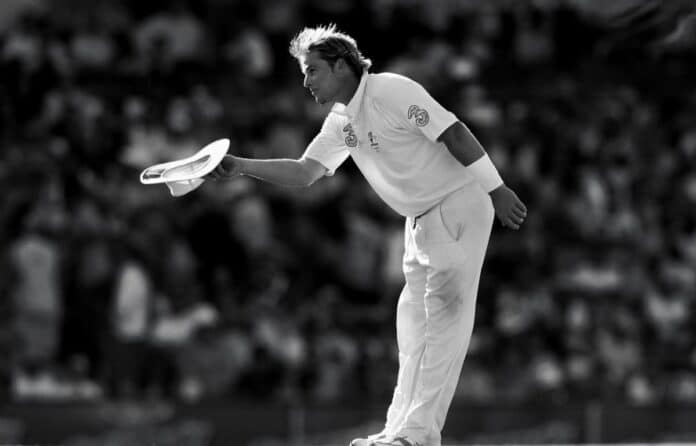
To say that Shane Warne bowled leg spin or to judge him on stats alone is to say that Pablo Piccaso merely painted. Warne, in an era where intimidation by pace ruled world cricket, brought spin back into fashion in the most remarkable way imaginable. Slow bowling was an art once again thanks to Warne, who weaved the brush so immaculately over 145 Tests that the final picture was a plethora of bamboozled batsmen, wonderful memories and a generation of inspired cricketers.
Shane Warne tribute: Batsmen mesmerised by spin, viewers mesmerised by beauty
Every Test cricketer has ability. After all, you can’t reach that level if you are a bad player. However, many have come and gone from Test cricket without realising their full potential as the game goes beyond talent.
Warne had all the attributes of a leg spin bowler; the ripping leg break, terrific wrong’un and famous flipper. Many others have graced Test cricket with similar attributes, but Warne stands head and shoulders above any leg spinner to play the game.
The King’s cricketing brain is unmatched. Yes, he could execute each of those deliveries with ease. His ball of the century to Mike Gatting, etched in the minds of millions, was his announcement to the cricketing world that something special was unfolding. Indeed, it is still incredible to think that delivery was his first in Tests in England. 12 years later in 2005, Andrew Strauss, among many others, suffered similar treatment in another memorable moment.
Yes, he can find any technical chink in a leg spinner’s bowling action as he did in a magnificent segment for Sky Sports in 2020. However, it was his mindset and understanding of the game that separated him from the rest; namely his ability to set a batsman up and then go in for the kill. Young cricketers grew up thinking that conceding a boundary is the poisoned chalice of bowling, but Warne taught that if it is part of a plan, then it’s worth giving up a few runs to take that vital wicket.
It’s a reason why his death has felt so personal for millions around the globe. Not only was Warne brilliant in his craft, but you would learn from his brilliance. When he bowled, you watched. Every delivery was an event. He was always aggressive in his approach, with wicket-taking at the forefront of his mind even though he didn’t necessarily try to take a wicket with each delivery.
As an example, think of poor Daryll Cullinan, whose pads and stumps would duck for cover when they would see Warne marking his run up at the other end. Richie Benaud, who said that Warne is the greatest bowler he’d seen, said in the clip below that Warne would “show them [the batsman]” a delivery or two before pouncing with the dream delivery.
Two greats of the game in-sync with one another. And Benaud’s judgement is one we all can appreciate.
England’s Alec Stewart fell prey to the same set up in 1994 after enjoying runs via cut strokes to the off-side boundary. After creating a false sense of security, Australia saw the back of Stewart thanks to Warne’s classic flipper that landed in almost the exact same spot as the slow leg-spinners that were crashed away. Stewart thought he could cut again, but was bowled before he could bring his bat down.
The genius of Warne in a nutshell.
Tribute to Shane Warne: The man who never said never
Warne epitomised what the great Australian teams of the 1990s and 2000s were about. If “risk it for the biscuit” were in the dictionary, Shane Warne’s face would be etched alongside it.
As a firm believer in risking a defeat to achieve victory, Warne made a generation believe that a win from almost any position was possible. Adelaide 2006 springs to mind right away, as a 13-year old who now writes this article came home from school to witness something he’d never forget for the rest of his life. Seven years earlier, in the famous 1999 World Cup Semi Final remembered mostly for one moment of madness, Warne ignited South African nerves with a game-changing spell that is etched in One Day history.
No was never an answer when Warne stepped out onto the field. If the opposition were to win, they would have to play out of their skin to do so against an Australian side that will fight to the very end with Warne in it. England held aloft the Ashes in 2005, but not before Warne took 40 wickets and batted magnificently against an attack at the peak of its powers.
Warne also left an undeniable mark on white-ball cricket. In addition to memorable ODI spells, Warne led the Rajasthan Royals to glory in the IPL’s first season back in 2008, where he has since always held a special place in the hearts of Rajasthan fans around the globe.
The sheer amount of tributes highlights Warne’s incredible impact
Such was his impact and iconic stature that my wife, who has no interest in or knowledge of cricket, knew who he was and was shocked at his passing. Non-cricketers such as Mick Jagger, Gary Neville and Ed Sheeran expressed their disappointment at Warne’s death. On a cricketing level, it’s hard to think of any player and pundit – past or present – who hasn’t yet paid tribute to one of the game’s best ever.
Australia Prime Minister Scott Morrison and Victorian Premier Dan Andrews offered his family a state funeral, which has been accepted. Also, the Great Southern Stand at the MCG, his beloved turf where he took his memorable hattrick in 1994 and 700th wicket in 2006, will be named the SK Warne stand.
If Harvard had a cricket course, Warne would be the top professor. When he talked tactics and spin, you would just shut up and listen. He was always an advocate for spin bowling, with the term “if it seams, it spins” associated with the King of Spin.
The pain of knowing we won’t hear such cricketing wisdom again cuts deep, but we should take heart that we were alive to witness Warne’s magic on the field and brilliant insights off it.
There will never be another Shane Warne. No doubt about it. He will be remembered forever.
Bowled, Shane.

