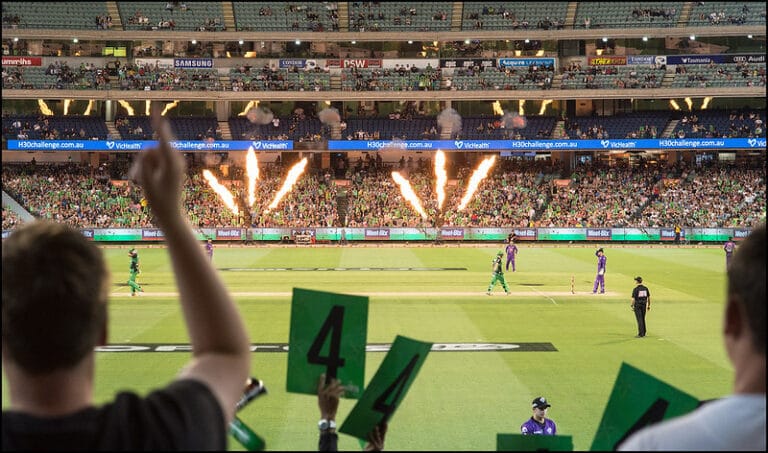
Bonus points, free hits for wides and a draft for overseas players are among the major changes that we could see in the upcoming Big Bash League season.
These, among other proposed changes, come at a time where the BBL is set to persist with a 61-game season (56 regular-season, five finals), despite the fact that BBL 09 was widely criticised for being too long.
The main reason for this is that the BBL’s organisers are concerned about the broadcasters – namely Fox Sports and Seven – requesting a discount on the current broadcasting deal should the season be reduced. Currently, the extended BBL season makes up about half of the mammoth $1.2 billion broadcast deal landed by Cricket Australia in 2018.
The BBL’s managers, including tournament head Alistair Dobson and CA’s executive in charge of events, Anthony Everard, have reportedly proposed some radical changes to on-field play in an attempt to boost the BBL’s attractiveness.
The following tweaks to playing conditions will be discussed in a meeting in July:
Free hits for wides, in addition to no balls.
Bonus points awarded to teams depending on their progress at the 10-over mark of their innings.
Teams can make tactical substitutions at the 10-over mark, should they wish.
Split powerplay: Four overs at the start, then two overs later in the innings.
Extra breaks for advertisements and player strategy. This could be every five overs.
A draft for overseas players.
Immediate reaction
Melbourne Renegades and Australian pace bowler Kane Richardson has voiced his concerns about the changes. He fears that some of the proposed rules will further disadvantage bowlers, which won’t necessarily improve the quality of cricket.
“I think I saw free hits if you bowl a wide, which I’m obviously not that keen on because we get that wrong occasionally so don’t think we should be punished that harshly”, Richardson said.
Also, Richardson pointed to the quality of the pitches as a key factor.
“The quality of pitches is something that’s maybe lacked in the last couple of years and they started to get that right last year.
“As long as the skill and the runs are there then think anyone will be happy.”
However, Richardson was in support of bonus points, as “it would make the ladder more interesting towards the backend of the tournament.”
Kane Richardson is worried about proposed changes to the Big Bash League.
Risks
More breaks will make the games drag on longer; not ideal given that the season ends after school begins.
Bowlers will be significantly disadvantaged, particularly around tight wide calls.
Tactical substitutions will change the game too much.
Top 5 Best Australia Test Matches Since 2000 | Australia Top 5 Best Test Matches Since 2000 | Best Australian Test Matches in 21st century
Test cricket, still considered the ultimate format in Australia, has dished up its fair share of memorable moments down under.
Australia have played 227 Test matches since 2nd January 2000. There have been countless golden moments, particularly from the golden era in the early-mid 2000s, that makes choosing the top five a difficult ask. So, let’s follow the below criteria:
Match context: Did Australia have their backs against the wall, or go above-and-beyond to produce a great win?
Series context: Was the series still alive?
A match that will still be spoken of for years to come.
5. Australia v India, 1st Test 2014, Adelaide
This was no ordinary Test. Australia and the world was reeling from the tragic death of Phil Hughes, and many, understandably, wondered just how the Australians would cope mentally.
The Australians, to their credit, kept going about their work as best they could ahead of the rescheduled series against India. They knew they had to dedicate this match to their little mate. It is what he would have wanted. A great win against a great rival.
They delivered.
David Warner, Michael Clarke and Steve Smith hit first innings centuries. India, led by the superb Virat Kohli, hit back with 444. But, after Australia then set India 364 on a wearing Adelaide pitch, many then feared the worst as India, led by Murali Vijay and Virat Kohli, stormed to 242/2.
However, in the game that truly catapulted Nathan Lyon’s career to greater heights, Australia escaped with one of their most memorable wins in the most emotional of circumstances. The last eight Indian wickets fell for 73 – Lyon took six of them (seven in total) – to cap off a stunning Test match. One for the ages.
4. South Africa v Australia, 3rd Test 2014, Cape Town
The Proteas, ahead of Graeme Smith’s final Test, were rampant. Dale Steyn was irresistible in the previous Test in Port Elizabeth, bamboozling Australia with reverse swing to level the series. So, surely, no one could deny the perfect farewell for the legendary Smith.
Enter David Warner and Ryan Harris. Warner scored two centuries, flaying the strong Proteas attack to all parts of Newlands. However, while he won Player of the Match, it was Harris’ incredible effort on the final day that is most remembered.
South Africa were hellbent on saving the Test (and series): four batsmen batted over 100 balls, Hashim Amla (109), AB de Villiers (228), Faf du Plessis (109) and Vernon Philander (105), while three others provided further resistance; JP Duminy (99), Kyle Abbott (89) and Dale Steyn (44).
But Harris, barely able to bend down to pick up a ball at gully due to a knee injury that required surgery, never gave in. In his mind, he had a Test series to win. 30 balls remained. Two wickets to win. Dale Steyn and Vernon Philander had batted 90 balls. But, Harris didn’t care. Despite having fluid causing bones to move in his knee, he continued to run in, and dismissed Steyn and Morne Morkel with two beautiful full deliveries that sent the Aussies into raptures.
The result may read that Australia won by 245 runs. Harris’ figures may read 25.3-15-32-4. But, no number could adequately portray the incredible effort of Ryan Harris in one of Australia’s most famous wins.
3. India vs Australia, 3rd Test 2004, Nagpur
No Test series win in India since 1969. Heartbreak three years earlier in Kolkata. The great Aussie side of the late 1990s and early 2000s had achieved just about everything, except a series win in India. They had to conquer the final frontier.
So, after India pushed Australia all the way in Australia a few months earlier, the Aussies knew they would have to play their best cricket if they were to break the drought. Michael Clarke’s heroics on debut put them 1-0 up in the series, and after rain intervened in Chennai, victory in Nagpur would rewrite history.
That it did. Led by Damien Martyn’s superb first innings century, along with contributions from Darren Lehmann, Simon Katich and Michael Clarke once again, Australia put India under serious pressure with runs on the board. And, when you have great pace bowlers like Glenn McGrath and Jason Gillespie (who took nine wickets), you’re always a chance.
In the end, they were better than just a chance. Adam Gilchrist, standing in for the injured Ricky Ponting, held his arms aloft as all ran towards deep midwicket, where Damien Martyn caught Zaheer Khan. History was rewritten, and we had confirmation that this Australian side was indeed one of Test cricket’s greatest.
It was one of the great quotes from Australia’s captain Tim Paine, when asked if there was a more intimidating ground in world cricket than Edgbaston. It riled the English up, and set the scene perfectly for the Ashes series ahead.
Truth be told, however, Edgbaston was not a happy hunting ground for Australia. Winless there since 2001, and with no series win in England since the same year, Australia started the 2019 Ashes as outsiders.
But, most significant was the return of banned trio David Warner, Steve Smith and Cameron Bancroft to the Test arena. And the England supporters let them know they felt. The atmosphere was rauscuous. It was intense. You had to have serious stomach to take all that in and focus on your game.
And Steve Smith did it best.
In his finest ever performance to date, Steve Smith turned boos into standing applause, as his twin centuries led Australia to a drought-breaking Edgbaston win. What made this performance most special was the predicament Australia were in on day one: 122/8 and on the brink of complete disaster to kick off an Ashes series. But, Smith stood firm, producing his finest century to date, of which the bowlers, led by Nathan Lyon, helped deliver a superb win for Australia against the odds.
England, holders of the Ashes after an all-time great series in 2005, were thrashed in the opening Test of the 2006/07 series.
So, they needed a bounceback in Adelaide. And, for much of the first three days, it was all England, playing from in front thanks to a first innings total of 551, followed by restricting Australia to 65/3. Surely, the worst result for England would be a draw. Not as good as win, but at least foothold in the series. Confidence. Something to build on.
Ricky Ponting’s century and the middle-lower order helped get Australia over 500 in reply. So, victory for England was out of the equation, but the draw would still be a good result. On the fifth morning, it looked all-but-certain, as they were just one down with a lead of over 100. Surely.
But don’t tell that to Shane Warne and Glenn McGrath. Their greatness is emphasised by the fact that they never settled for the minimum. They wanted to achieve the impossible. And this was such a situation. With every wicket, England began to panic, and that’s all the legends needed as they smelt blood in the water. With 6/64 in 42 overs between them, along with Brett Lee’s superb 2/35, McGrath and Warne inspired an England collapse; all out for 129, leaving 168 for Australia to get in the final session.
Justin Langer’s strong swipe through midwicket in the second ball of the chase indicated Australia’s mindset. They weren’t going to let this one slip. As the crowd swelled as the evening drew near, the two Michaels – Hussey and Clarke – steered Australia home, with Hussey’s winning cover drive, etched in Australian cricket folklore for many-a-year to come.
Although there were still three Tests to play, the Ashes were all-but-decided. Skipper Andrew Flintoff walked off a dejected figure. So did his teammates. England went on to lose the next three Tests heavily, relinquishing the urn in the most disappointing way posssible – a 5-0 defeat.
Rajasthan Royals: Underperformers or Exceeded Expectations? | Have Rajasthan Royals underachieved in IPL? IPL Analysis | Will RR win IPL 2020?
They won the first-ever IPL when no one even thought that they’ll qualify for play-offs. It formed the beginning of quite an interesting journey that Rajasthan Royals have had in the IPL.
Here, it’s time to talk about their journey and their performance in the league. Have Rajasthan Royals underperformed or have they performed better than expectations?
The Journey: A bright start
2008 was like a dream for the Royals. They appointed Shane Warne as their Icon Player and Coach in the inaugural season of the IPL, when every team was going for big, Indian names like Sachin Tendulkar, MS Dhoni and Virender Sehwag. Management had a vision, reflective in their picks in the auction, and it paid off.
Rajasthan, known for giving a chance to the youngsters, had a very young and inexperienced squad. Skipper Shane Warne, Graeme Smith, Mohammad Kaif, Sohail Tanvir, and Shane Watson were the only well-known names in the side.
Warne, just like his bowling, produced magic with that team, going on to win the first IPL Title, defeating the mighty CSK in the Final. Young players like Ravindra Jadeja, Yusuf Pathan, Swapnil Asnodkar, Siddharth Trivedi and Munaf Patel contributed significantly in the team’s success.
The Journey: A rocky sequel
However, after such a dream opening season, Rajasthan saw a significant dip in their form. They have played nine seasons since, qualifying for the playoffs just three times (2013, 2015 & 2018), finishing sixth or seventh on five occasions. More, they have not appeared in the Final since 2008, despite having better squads compared to that season.
They performed particuarly poorly during the 2010-2012 seasons, finishing twice in seventh and once in sixth. This is despite boasting players like Shane Watson, James Faulkner, Rahul Dravid, Ajinkya Rahane, Johan Botha, Shaun Tait and Owais Shah.
An underachievement.
But, they improved in 2013-2015, qualifying for the playoffs twice. The only time they missed the playoffs during this period was in 2014, falling short against Mumbai Indians in one of the best T20 games. They also had a close miss against Mumbai in 2013, finishing runners up in the CLT20 tournament. Players like Binny, Samson and Cooper performed well with Watson, Rahane, Faulkner and Hodge.
So, RR had a very strong squad during that time, of which they could look to build on.
The Journey: The rockiest part and return
But, the worst followed. The spot-fixing incident. Rajasthan Royals were suspended for two seasons, along with Chennai Super Kings.
So, when the time came for their return, how would they cope?
They returned in 2018-19 with arguably their best squad ever. Players such as Jos Buttler, Steve Smith, Ben Stokes, Jofra Archer, Ajinkya Rahane with youngsters like Riyan Parag, Shreyas Gopal, Krishnappa Gowtham made for a fine team.
As has been the case in the past, though, they didn’t perform the way they would’ve liked.
The Journey: Their record
However, despite the ups-and-downs, Rajasthan have the fifth-best win percentage in IPL. This is superior than the percentages of RCB, KXIP, and DC; sides who were deemed to have better squads than Rajasthan over the years.
Rajasthan Royals: 5th best IPL win percentage (51.37%)
So the question still remains; have RR underperformed or exceeded everyone’s expectations?
One thing for certain is that RR have been unpredictable. Even inconsistent. Or, you can go as far to say they have underperformed. No one thought they’d even qualify for the playoffs in the 2008 season, and they won it. Then, a team consisting of players like Watson, Faulkner, Rahane, Dravid, Tait, Hodge (in 2012) and Buttler, Archer, Stokes, Smith, Samson, Rahane (in 2019) have finished seventh in the points table.
TheReason
Let’s try to find out why they’ve been underperforming most of these years.
Over-dependency on overseas players is a major problem. RR are known for backing young players, rather than going for more experience. As a result, this increases the responsibility on the overseas stars.
Also, a crucial factor is that their most important players (Buttler, Stokes, and Archer) are English. More often than not, they leave the tournament when RR need them the most, as England’s preparations for their home summer ramp up as the IPL nears its end.
With this focus on overseas stars, RR lack an experienced core of Indian players like other teams such as MI and CSK. This is not to say that the young players don’t perform, but you need experience in the side to guide them along the way.
Captaincy is another area where they have lacked behind other teams. They have been unsuccessful in taking Warne’s legacy forward. Dravid was a good skipper, but after that, persisting with Rahane as skipper wasn’t a great move. You need someone who can bring the best out of the young players. One who can make them believe. Just like Shane Warne did in 2008. However, Rahane, unfortunately, failed to do that. He has been a great player for RR, but this didn’t translate to his captaincy.
Verdict
Rajasthan Royals exceeded everyone’s expectations in 2008. However, after that, they haven’t performed the way anyone expected, despite having stronger squads.
Overall, they have underperformed as a team and management. The strength in their squads in the past few seasons indicates they have performed well below their potential.
However, the current side looks strong. Hopefully for their fans, RR will perform as their potential suggests in the upcoming seasons.
Thanks for reading!
Written by Robin Rounder. Follow Robin on Twitter today.
Check out more of Robin’s articles on CricBlog, including:
After a dose of cricket puns and jokes? You are in the right place. Here are 20 such jokes that will either make others laugh, or look at you with total confusion on their face.
It’s funny either way, and depends on how interested someone is in cricket! If you have any classic cricket puns, do share with us in the comments section below or write to us @cric_blog on X (formerly Twitter).
1. England found some success against Australia in the mid-2000s. Why? Waugh stopped and they found peace.
2. What’s the difference between Cinderella and a batter who keeps nicking off Cinderella knew when to leave the ball.
3. What is a batsman’s least favourite bird? Duck.
4. Why are fielders in the deep so well behaved? They know their boundaries and will try to stay within them.
5. Why didn’t the cricket team believe their captain? He had a very silly point.
6. Why is it never a good idea to take a batsman, who is scared of the short ball, out to a nightclub? He always gets into a tangle with the bouncer.
7. There is no sport that accepts a diverse range of body types like cricket does… Fine legs, square legs and short legs.
8.Girlfriend is excited about the new two-piece she bought for our vacation. Does she not realise I’m a handful with the swinging ball?
9. Why is it safe to get with a cricketer after a night out? We always wear protection.
10. Why are bad tailenders and great racecar drivers so similar? If you blink, you’ll miss them both.
11.Did you hear about the guy who was so happy he found a girlfriend who loves playing cricket? She bowled him over.
12. Why are cricketers so good at ironing shirts? We know how to spot a crease.
13.What is Shane Watson’s least favourite fruit? Plum.
14. Why do cricketers have more fights with their partners than ever before? They feel they can overturn any decision even if they have no chance of success.
15. My wife said she would leave me if I don’t stop obsessing over cricket. I asked her to review that statement, with the “T” sign.We are no longer together.
16. What did the snow skier ask the West Indies cricket team? Tips on how to go downhill so fast.
17. Which cricket grounds are the coolest? The ones full of fans.
18. Why is a bad fielder always feeling healthy and free of illness? They don’t catch anything.
19. When is the only time a batter feels they are out? On a Saturday night.
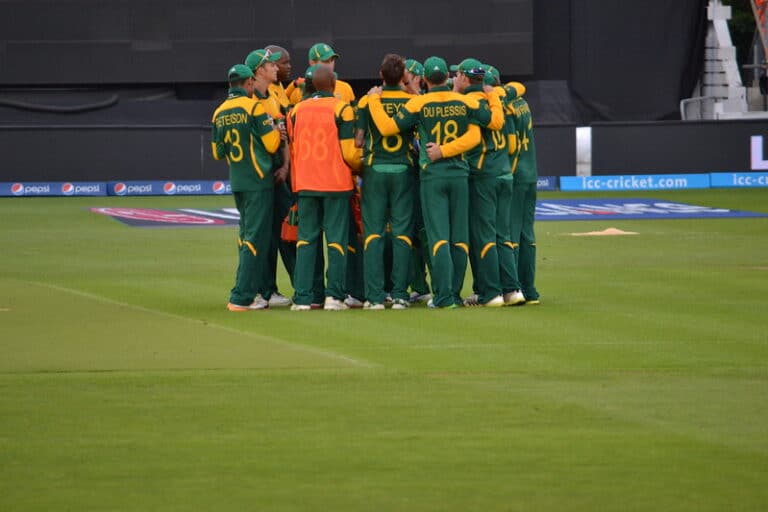
T20 World Cup & Global Trophy: Too Little Too Late for Proteas? | Can South Africa win the T20 World Cup? Proteas in T20 cricket: Do they have what it takes?
“Quite frankly, the one-day game in England was a mess four years ago; light years behind the rest of the world. There was no plan in place, the team had no identity, the selection was all wrong’’ – World Cup winning captain Eoin Morgan after their successful 2019 ODI World Cup campaign.
What did England do after that humiliating 2015 World Cup group stage exit? They hired a new director of cricket, new coach, and implemented a new game plan; a plan that identified ‘white ball specialists’ and allowed them time to settle within the side, with a very clearly-defined role.
Where do the Proteas lie now?
Where England were in 2015 sounds a bit like the current state of South African cricket.
The journey for the Proteas T20 side, leading into the upcoming World Cup, has not been as smooth as they would have liked. With the tournament likely to be in the near future (despite doubts), it still may be all too late for such plans to be implemented.
The Proteas have used 24 different players in their playing XIs in their past 10 T20Is (dating back to March 2019); a serious indication of the lack of a game plan going into the tournament.
Of course, preparation and ‘game plans’ go far beyond a mere playing XI. The composition of the side is also important. Is six batsmen, one all-rounder and four bowlers the best option? Will the Proteas give up a batsman for an all-rounder to add a sixth bowling option? One or two spinners? Who takes the new ball? Who opens the batting with Quinton de Kock? Will AB de Villiers and Imran Tahir be available?
Siyasanga Mbambani/DoC: Will the brilliant AB de Villiers be available?
These are a few of the questions that need answering long before the Proteas board that flight to Australia. Unfortunately, those in charge of making such decisions are as unsure as they have ever been heading into a T20 World Cup; a tournament South Africa have been eliminated in the second round in four out of six occasions.
The most frustrating part for fans is that South Africa undoubtedly have the raw material to go all the way. On paper, South Africa are as strong as any other side at the tournament, boasting world class talents like Quinton de Kock, AB de Villiers (if available), Dale Steyn, Kagiso Rabada and Imran Tahir (if available).
The good news is that the Proteas could get some much-needed breathing room, with World Cup potentially postponed to next year. This is crucial after sustaining back-to-back home series defeats to England and Australia.
Cricket South Africa have been able to schedule a highly-anticipated three-match T20I series at home against a powerful Indian side, which could be their last their T20 assignment before the World Cup. What should happen in that series, if South Africa are to have any chance at being competitive, is the following:
Who will support the talented Quinton de Kock?
1. Pick a squad and stick with it between now and the World Cup
There will likely be very little (if any) T20 cricket between now and the World Cup to impress national selectors. So, players will be picked based on past performances at domestic and international level, as well as work ethic behind the scenes.
Recent performances, i.e. current form, should carry greater weighting when selecting a squad. The players that excelled against the likes of Australia and England should retain their spots.
A prime example is the rotation between Reeza Hendricks, Aiden Markram, Janneman Malan and Temba Bavuma as Quinton de Kock’s opening partner. Bavuma put his hand up against England and played a number of handy innings as well as an impressive ‘brand’ of cricket that South Africa’s white ball cricketers must adopt.
Bavuma should partner de Kock at the of the order. Let them develop a relationship, and allow them time to ‘mold’ into that role.
2. Players need to make their intentions known immediately
There is still lots of uncertainty around the likes of AB de Villiers, Imran Tahir, and Chris Morris; three players who would significantly improve the quality of any Proteas T20 side. More importantly, they are three players who would undoubtedly increase South Africa’s chances of being successful at the World Cup.
Whether they should be allowed to return to the Proteas setup is a different debate altogether. One that we can have at a different time. But, for now, many wouldn’t argue that the experience they’ve gained as ‘superstars’ of the global T20 circuit will only be beneficial. If they are not part of the squad against India, it is hard to see them being part of the World Cup squad.
3. Clearly defined roles within the side
Will Quinton de Kock go after the bowlers from ball one? Should David Miller be in as early possible or should he be saved for the final four overs?
Does Rabada start with two overs upfront and save two for the death? Or should all four be saved for the latter end of the innings? Who bowls the last over when the opposition need six?
Do the spinners only bowl after the powerplay? Or is there confidence to bowl spin in the first six overs? Does that depend on who South Africa are playing against?
It is one thing to have a team that is comprised of 11 quality players, but the most successful teams, especially in knockouts, have always known exactly what each player’s role is.
Glenn McGrath’s forte was upfront with the new ball, bowling consistent line and length. Brett Lee was more for the death overs. For South Africa, Paul Harris was never going to spin webs around a top order, but Graeme Smith knew exactly how to use him. More importantly, Harris himself knew what his role was within that legendary bowling unit.
On a more positive note, it is fair to say that the Proteas are not real ‘title contenders’ right now. Can they win the tournament? Absolutely, they can. But, are they front runners? No, they are not.
South Africa are in the dark horses category, with the likes of New Zealand and West Indies, which has the potential to ease a bit of pressure on the boys down under.
Having said that, cricket fans will always go into a tournament with hope (and expectations) that our country can win the tournament. Given the unpredictable nature of T20 cricket, along with the pressure that comes with knockouts, quite literally anything could happen.
I, for one, am backing the boys to go all the way.
Written by Daniel Orsmond. Follow Daniel on Twitter today.
Will the 2020 World T20 Go Ahead? 3 Reasons Why It Might Not | Will the 2020 T20 World CupHappen This Year? Will IPL Replace the T20 World Cup?
It was the year of T20. After a successful Women’s World T20, headlined by a magnificent turnout at the Final, attention then turned to the men’s edition to be held in October-November.
However, all cricket came to a standstill in March, which immediately threw the World T20 in doubt. The ICC has deferred the final call until June 10, but the reality is that the tournament is under “very high risk”.
Namibia, Papua New Guinea and Oman will feature in the Qualification Stage of this year’s tournament, which makes this situation a disappointing one for them. Also, Cricket Australia would lose an estimated AU$20 million should the tournament not go ahead. These parties will hope it goes ahead, but the below are three key reasons why it might not.
1. A World Cup with no crowds? Not ideal.
Australian Sports Minister, Richard Coelbeck, said that the absence of crowds could mean the World T20 doesn’t go ahead.
Now, COVID-19 restrictions are easing in Australia. However, that does not mean that stadiums will be full by the time October-November comes around. Whether restrictions lift further will depend on how things fare in June-July; governments will open stadiums to the public only if they deem that it is completely safe to do so.
The issue with that is the ICC is seeking to make a decision in early June. So, the game’s governing body will need to make a decision with what is front of them, and given that the pandemic is still rife around the globe, it could mean the tournament is postponed, likely to 2021 or 2022.
AUSvNZ ODI earlier in 2020: A World Cup behind closed doors is not ideal.
2. Logistical Arrangements
15 teams will compete in this year’s World T20, with 45 matches to be played across seven different venues. With international travel at a standstill given the pandemic, as well as certain states still closing their borders in Australia, the tournament organisers will have to negotiate and iron out all the logistical arrangements to get this tournament going.
Also, the 14-day isolation period required for all arriving in Australia adds to the challenge.
It would be a shame for Namibia if WT20 doesn’t go ahead.
3. IPL
Originally scheduled for March 29, before postponed to April 15, the IPL is suspended indefinitely due to the COVID-19 situation in India. However, the Indian govenment has begun relaxing restrictions on sporting events, allowing them to take place behind closed doors.
This means that IPL could still take place in 2020.
Given that the BCCI, which generates approximately 80% of ICC’s revenue, will lose an estimated Rs. 4000 crore (US$529.6M), organisers will do whatever they can to ensure the tournament goes ahead, even with no crowds.
Should the World T20 not go ahead, this opens up the possibility of India staging IPL 2020 in the October-November window. Also, in contrast to the World T20, it puts onus on individuals choosing to travel to India for the IPL, rather than 15 countries.
So, if the IPL can go ahead, you feel that organisers will do everything they can to make it happen.
Seeking some cricket content during self isolation? Check out some content on CricBlog:
Australia-Zimbabwe ODI Series Scheduled for August 2020 | Australia vs Zimbabwe ODI Series | When will cricket resume?
Zimbabwe’s tour of Australia, currently scheduled for August, could go ahead as planned as COVID-19 restrictions continue to ease in Australia.
This tour comprises of three ODIs, all to be played in the northern parts of Australia. Darwin, Northern Territory, is the preferred location for the first two ODIs. Townsville, North Queensland, also in line for cricket action.
Australia-Zimbabwe ODI Series could be behind closed doors, like the Australia-NZ ODI earlier this year.
If Townsville does get the green light, it will be its first taste of ODI cricket that involves Australia. The city previously hosted ODIs and T20Is between 2014 and 2016 involving Papua New Guinea, Hong Kong and Ireland.
Northern Territory currently has no active cases of COVID-19. Since the outbreak, Northern Territory has had just 29 cases in total, with no deaths.
However, whether this series goes ahead hinges on how Australia fares in the coming weeks. This also applies to whether there will be any crowds. CA CEO Kevin Roberts has acknowledged the challenges, but is working to ensure international cricket goes ahead.
“We know that circumstances or events beyond our control could mean that the final schedule potentially may look different to the one released today. But, we’ll be doing everything we can to get as much international cricket in as possible this summer. We will communicate any changes to the schedule if or when they are required.
“We are engaged in ongoing discussions with federal and state governments, our venues and the touring nations to continually understand and monitor the situation in front of us, which is evolving every day. We’ll continue to act in accordance with public health advice and government protocols to ensure the safety of the public, players and support staff.”
This news comes in as Australia have penciled in a tentative Test schedule, comprising of a one-off Test vs Afghanistan and four blockbuster Tests vs India.
Australia vs Zimbabwe ODI Series Schedule:
1st ODI: August 9, Venue TBC
2nd ODI: August 12, Venue TBC
3rd ODI: August 15, Townsville
Seeking some cricket content during self isolation? Check out some content on CricBlog:
Cricket Australia has announced their tentative Test schedule for the upcoming 2020/21 season, with an inaugural Test against Afghanistan and four blockbuster Tests against India on the menu.
Cricket could return to Australia in the coming months, as COVID-19 restrictions ease right across the country. COVID-19 forced a cancellation of all sports in March, but now, the NRL and AFL, two of Australia’s major footballing codes, are all set to get underway (NRL May 28 and AFL June 11).
However, it remains to be seen whether crowds will feature in the Australian summer. It could all depend on how Australia fares in the next two months or so, with the fate of the World T20 to also be made clearer in the next 24-48 hours.
Australia’s Test Season
The Australian Test season will kick off on November 21-25 at the Optus Stadium in Perth. Afghanistan, Test cricket’s newest team, are set to play Australia for the first time ever in Test cricket. This will be a Day/Night match.
Then, Australia return to fortress Gabba in the first of four Tests against India. The Aussies will look to regain the Border-Gavaskar Trophy, after Virat Kohli’s men retained it with 2-1 series win in Australia in 2018/19.
The Aussies haven’t lost a Test at the Gabba since 1988 (31 matches); the longest unbeaten streak by any side at a single venue. However, Virat Kohli, speaking in January, was relishing the challenge to break this streak.
“Whether it is the Gabba or Perth, it doesn’t matter to us,” Kohli said.
“We have the skillsets as a team to compete against anyone in the world anywhere, whether it is white ball, pink ball or red ball.
“We are absolutely up for it.”
The Adelaide Test, which follows Brisbane, will be played with the pink ball. Australia have won all their seven D/N Tests (all played at home). On the other hand, India have played just one D/N Test, thrashing Bangladesh at home in November.
Mitchell Starc, who has 59 wickets in D/N Tests at 18.63, is relishing the chance to perform well against India with the pink ball.
“I think absolutely a pink-ball Test in the series against India is a great thing,” Starc said.
“The fans love it, I think it creates a different aspect to the contest, bat and ball are closer together in that contest.
“India played a pink-ball game in India so they’re not completely foreign to it
“In terms of an advantage, if you like, we do have a good record at home with the pink ball.”
The Boxing Day Test (Melbourne) and New Year’s Test (Sydney) will round out the Test season.
Australia Test Schedule:
Only Test vs Afghanistan: 21-25 November, Optus Stadium, Perth (D/N)
1st Test vs India: December 3-7, Gabba, Brisbane
2nd Test vs India: December 11-15, Adelaide Oval, Adelaide (D/N)
3rd Test vs India: December 26-30, MCG, Melbourne
4th Test vs India: January 3-7, SCG, Sydney
Seeking some cricket content during self isolation? Check out some content on CricBlog:
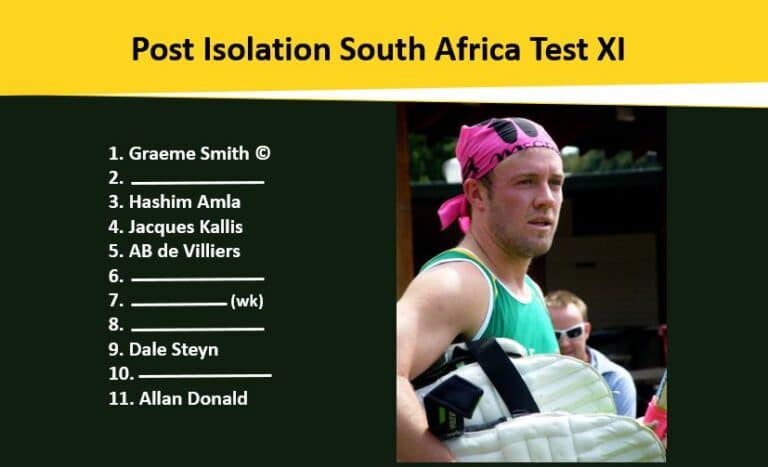
Opinion: Post-Isolation South Africa Test XI | South Africa Test XI | South African Dream11 | Best South Africa XI since Isolation
For the purpose of this write up, I will be looking solely at the post-isolation period of South African cricket. Simply put, I will be looking at the period 1991-2020, which provides three decades worth of cricketers to choose from!
First opener and captain
Starting at the top of the order, there can be no doubt about my opening batsman and captain Graeme Smith. With 117 Tests and 9,265 runs to his name, he, alongside Alastair Cook and Matthew Hayden, are without a doubt three of the greatest opening batsmen in the modern era.
His batting aside, Smith boasts the record of being the most-capped captain in the longest format. Also, his staggering 49%-win record places him above the likes of Allan Border, Stephen Fleming, MS Dhoni and Alastair Cook.
Post-Isolation South Africa Test XI: Graeme Smith is an easy choice.
Second Opener
His partner at the other end was a far tougher decision to make. Eventually, I was able to eliminate all but Gary Kirsten and Herschelle Gibbs. They were chalk and cheese in terms of how they went about their craft, but both were highly effective against the new ball.
At face value, Gary Kirsten seems the logical option with an average of 45 and 21 hundreds, compared to Herschelle Gibbs’ 42 average and 14 hundreds. However, upon further inspection, you’ll find that Gary Kirsten’s average is ‘bloated’ by his average of 71 batting at number three and in fact averages 41 as an opener. Gibbs’ average, on the other hand, is weighed down by his performance batting in the middle order. If we isolate his stats as an opener, Gibbs boasts an average of 47.
Post-Isolation South Africa Test XI: Gibbs had a strong record as Test opener.
That being said, I still believe these stats lack some context. What really matters in my opinion is how these players perform against quality opposition.
Key question: How have they fared against the likes of mighty Australia, England and India?
In 88 innings, Gary Kirsten managed 3462 runs at an average of 41.21. In contrast, Gibbs accumulated 2563 runs in 73 innings at 35.60. The decision became easier at this point. If I’m honest, I’ve always had a bit of a soft spot for the nuggety, gritty and almost ‘ugly’ type of openers, compared to the flashy and elegant guys for whom batting seems to come too easily.
Post-Isolation South Africa Test XI: Kirsten wins over Gibbs.
Middle Order
I didn’t lose a wink of sleep thinking about who could possibly fill the 3-5 positions. Between Hashim Amla, Jacques Kallis and AB de Villiers, the meat of my middle order has over 31,000 Test runs. They average 47, 55 and 51 respectively, with the added bonus of Kallis operating as my fifth bowler.
More, they have been successful against all opponents, in all conditions and across formats.
These three have formed a key part of the most dominant Proteas side to ever exist. I do not accept any debate when it comes to them.
Post-Isolation South Africa Test XI: Three incredible players
Numbers six and seven
My middle-lower order proved to be a slightly tougher decision. Having Kallis in the side does allow me to pick an extra batsman and obviously one of 6-7 must keep wicket.
My ideal number six needs to be a gutsy player; someone who could weather an unlikely top order collapse, and really knuckle down with a stroke-playing number seven. The number seven should have the ability to score freely in the event of having to bat with the tail. Selecting my seven first; the obvious decision is between:
Mark Boucher, who holds the record for the most Test dismissals as a keeper, and;
The young-but-highly-destructive and talented Quinton de Kock.
As it stands, Boucher is probably the better gloveman. However, I’d argue that they are worlds apart when it comes to their batting. I can think of nothing more demoralising for an opposition captain than to have Quinton de Kock stride in after all those greats, with his ability to take the game away from you within a single session of play.
Boucher’s cricketing mind and experience will definitely be missed, but with the likes of Smith, Kallis and AB in that slip cordon, I believe there is enough experience to go around. Quinton de Kock slots in at seven.
Post-Isolation South Africa Test XI – Quinton de Kock is an exciting batsman.
Going back to my number six; there are a handful of players and a handful of variables to consider. Many might assume that Daryll Cullinan, with his 44 average, is the obvious option.
However, I have two main reservations here. Firstly, Cullinan batted at four for 84% of his career. In fact, he only operated as the number six once in 115 innings. Secondly, although his overall stats look impressive, his average of 12 against Australia leaves a lot to be desired.
JP Duminy, probably the most conventional, talented and elegant number six of the players considered, never really lived up to his potential. His Test career ended with modest average of 33 (25 batting at six). His record against Australia is something to be admired, but unfortunately he has not done enough to earn himself a position in the Proteas XI.
The late Hansie Cronje is another player that comes to mind, who too seemed to perform above average against the Aussies. However, he struggled to replicate that form against the likes of India and England. Furthermore, with an average of 28 in eight innings while batting at number six, he also has not done enough to earn himself a place amongst these legends.
So, with Cullinan, Duminy and Cronje excluded, we’re left with two players:
Ashwell Prince, an immensely talented and mentally tough left-hander, with a wide variety of strokes, who helped the Proteas out of more than one sticky situation throughout his career and;
Former Proteas test captain, Faf du Plessis.
Let’s compare them:
Post-Isolation South Africa Test XI – Prince vs du Plessis
There is of course very little difference between these players. Prince has a marginally higher career average and average against stronger opposition. du Plessis has the higher average batting at six and a particularly good record against Australia.
They both have an impressive resume when it comes to digging South Africa out of a hole. But, in the end, I simply asked myself who I would choose to bat for my life. Between these two guys, Faf du Plessis’ debut heroics against the Aussies down under is an innings I wont forget anytime soon. He slots in at six.
Post-Isolation South Africa Test XI – Top Seven
Bowling Attack
Spinner:
For the sake of balance, I will go with three seamers and one spinner, with Kallis the fifth option. This might seem strange given the plethora of fast bowlers that have come out of South Africa over the last 30 years, but I believe an attack consisting of five right-arm fast bowlers is a bit one-dimensional.
With a strike force coming from the likes of Allan Donald, Shaun Pollock, Makhaya Ntini, Dale Steyn, Morne Morkel, Vernon Philander and Kagiso Rabada, you can imagine that the role of my spinner will not necessarily be to try and take wickets. Rather, he should be able to keep an end tidy while I rotate my quicks in short spells from the opposite end.
It’s no secret that South Africa is yet to produce a ‘world class’ caliber spinner. However, I do believe that Paul Adams, as well as Keshav Maharaj, have been successful at the highest level.
They will be my two contenders for the spinner role.
There is a common misconception among South African fans that Paul Adams was the (expensive) wicket taker, while Keshav Maharaj has the ability to keep an end quite without bothering the batsmen too much.
However, if we look at the numbers, you’ll find that Paul Adams was the more economical of the two. Maharaj, although moderately more expensive, tends to pick up wickets at a faster rate than Paul Adams. Upon further inspection, Maharaj appears to have struggled against major opposition (India in particular) and averages nearly 43 against the likes of Australia, England and India.
Adams, on the other hand, relished the opportunity to play against the Indians, averaging 23.73 against them. More, he averaged 31.19 against the aforementioned ‘big three’ Test sides. He is arguably the more skilful of the two bowlers, and although his action is unorthodox, his variety will compliment my three right arm quicks.
Post-Isolation South Africa Test XI: Keshav Maharaj just misses out.
Fast Bowlers:
To complete my XI, I want three wicket takers. I’m not looking to strike the perfect balance between swing, seam, and pace bowling between the three. I simply want the three most destructive fast bowlers that South Africa has produced in the last 30 years.
It goes without saying, but it does become difficult to compare players from different periods of the game. Stats alone cannot tell the full story, but I do think it is a good starting base.
Pace Bowling Stats:
With an abundance of fast bowling legends, it seems cruel to ask a person to pick the best of the best. But, if I were to toss the ball to each of these players and ask them to all pick up a wicket, Rabada (according to his strike rate of 40.6) would be first. Steyn second. Donald third.
If I were to ask each of these players to pick up a wicket whilst conceding as little runs as possible, Donald would be my go-to guy. Followed by Philander. Then, by Steyn and Rabada, who both average 22.95 runs per wicket.
In terms of how ‘destructive’ they are, Rabada requires only 19.5 innings to pick up a 10 wicket haul. Steyn around 34 innings. Donald closer to 43. Looking solely at five-wicket hauls, the same names appear: Donald, Steyn and Rabada.
All three have bowled north of 150 clicks at a point in their career. All have all been successful against major opposition. And, all have had success in conditions that don’t necessarily suit fast bowling. Steyn and Rabada are the more skilful of the three, both able to move the ball either way at high speeds. Donald relied slightly more on his aggression and pace, often taking wickets through sheer determination and relentlessness rather than through masterful swing or seam bowling.
The trio view bowling as a personal battle between them and the batsman. Dale Steyn is one of, if not the only bowler, who would geniunely get quicker and quicker throughout the day. More, I cannot think of another bowler in world cricket who I would rather turn to if I was desperate for a wicket leading into the end of the day’s play. Graeme Smith certainly thought the same.
I would toss the new ball to Allan Donald and Dale Steyn. If a batsman had the temperament and ability to handle them, then comes a barrage of hostile fast bowling from the young Kagiso Rabada; a situation that I’m sure no batsman from any era would like to find themselves in.
A wonderful attack to top off a superb top seven.
Post-Isolation South Africa Test XI
Written by Daniel Orsmond. Follow Daniel on Twitter today.
Top 5 Best India Test Matches Since 2000 | Best Test Matches for India since 2020 | What is the best India Test Match? Best India Test Matches
India have been involved in many memorable matches since 2000, across formats. This includes matches against Pakistan, although we don’t see the great rivalry as often as we should.
However, in 211 Tests since January 2nd, 2000, India have been involved in Test matches so memorable that they are still spoken of as if they happened yesterday.
As a result, choosing India’s top five Tests over the course of 20 years is a challenge. There have been many, including memorable wins over England, Australia, South Africa and the like. So, the selection of the top five is based on the following criteria:
Match context: Did India have their backs against the wall? Considered next-to-no-chance of winning?
Series context: Was the series still alive?
A match that helped shape Indian cricket and inspire a nation.
5. England vs India, 2nd Test 2007, Trent Bridge
India won a Test in England in 2002 (Headingley), which was a landmark moment. India had won just two Tests in the country in their previous 41 attempts.
However, their win in 2007 at Trent Bridge was more special. In the previous three summers before the 2007 series, England had smashed New Zealand and West Indies (2004), beat Australia in the memorable 2005 Ashes, drew to Sri Lanka and beat Pakistan 3-0 (2006).
England were on a roll. India escaped with the most thrilling of draws in the first Test, but it was widely expected that England would do what they did to Australia in 2005 – build on such a close miss and then win the series. However, led by Zaheer Khan and their great batsmen, India inspired belief that they could win more matches overseas, en-route to their first series win in England since 1986.
Photo by Laurence Griffiths/Getty Images: Rahul Dravid & Sourav Ganguly
4. Australia vs India, 2nd Test 2003, Adelaide
One of India’s greatest ever Test matches.
Most people would have thought that only two results were possible: an Australian win or a fighting draw from India when Australia piled on 556 in their first innings, led by Ricky Ponting’s 242,. Then, when India were down-and-out at 85/4, an Australian win seemed inevitable.
However, Rahul Dravid (233), the only batsman to face 30,000+ balls in Tests, and VVS Laxman (148) tormented Australia once again. They slammed a 303-run stand that formed the biggest chunk of India’s huge 523.
But, one big batting total is not enough to win a Test; your bowlers need to step up to the plate as well. Ajit Agarkar did just that, taking 6/41 to bowl Australia out for 196. Crucially, India took just 56.2 overs to roll Australia, which gave their batsmen time to chase 233. Led by the great Rahul Dravid once again (72*), India got home by four wickets in one of their greatest triumphs.
Australia’s 556 is the fourth-highest first innings score to result in a defeat in Test history, and Australia’s second-highest. A great effort from India.
India Test Matches: Rahul Dravid played many-a-great innings in SENA.
3. India vs England, 1st Test 2008, Chennai
This was more than just the result. It was an outpouring of emotion.
India was rocked by a terrorist attack in Mumbai just weeks earlier. So, England’s tour of India was understandably thrown into doubt. But, when it went ahead, only the most optimistic Indian fan could have dreamt of what happened next.
Just two years earlier, England thrashed India in Mumbai, as India failed badly in their quest of a 300+ fourth innings score. But, Chennai 2008, one of the finest moments for both Virender Sehwag and Sachin Tendulkar, was a different story.
Set an improbable 387 to win a turning track, Sehwag, who won Player of the Match, rocked England early with a stunning 82 off 68 balls. The Little Master then walked in to bat early on the fifth morning after Dravid was dismissed cheaply. The rest was history, as Tendulkar produced one of the great fourth innings hundreds you’ll see, in conjunction with Yuvraj Singh’s superb unbeaten 85* (131) to get India over the line by a stunning six wickets. A win for the ages.
India Test Matches: Sachin Tendulkar was a master at work.
2. India vs Australia, 1st Test 2010, Mohali
Mohali 2010. A match that haunts Australia fans. One that puts a huge smile on the face of every Indian fan who witnessed it.
After both sides scored 400+ in contrasting fashion (Australia steady, India rollicking), the game opened up in the third innings, as most great Tests do. India’s effort to bowl Australia out for 192 gave them a very gettable 216 to win. However, with the pitch showing significant signs of wear and tear, India kept crashing under the waves of Australian pace bowling pressure, falling to 124/8.
A loss was inevitable. One that would have been condemned by all in India, given that Australia fielded only one specialist spinner – the much-maligned Nathan Hauritz, who only bowled just nine overs out of 58.3, and went at five an over.
But, when VVS Laxman is at the crease, anything is possible. He and the stubborn Ishant Sharma (31 off 92 balls) raised hopes of a miraculous comeback with every boundary and forward prod respectively, eventually taking India to within 11 runs of victory.
However, a game like this was not going to end without further drama. Laxman, suffering from a sore back, needed a runner. Ishant, who batted so stoutly, was given out LBW when the ball was heading way down leg. Pragyan Ohja, India’s number 11, was a nervous wreck, refusing to run when Suresh Raina called him for a single. VVS Laxman was famously furious. Then, Ohja was plumb LBW, only for Billy Bowden to give it not out, before Steve Smith threw the ball for four overthrows in a run-out attempt.
Two leg-byes later, India had their amazing win, which was one of their great escapes. Australia were crestfallen, going on to lose the two-match series 2-0.
India Test Matches: VVS Laxman was superb for a decade vs Australia.
1. India vs Australia, 2nd Test 2001, Eden Gardens
Shut the gates. While picking four of India’s other great wins in a top five was difficult, the number one pick is straight forward. Eden Gardens 2001 is a match no India fan will ever forget.
Australia hadn’t won a Test series in India since 1969. Steve Waugh’s side, on the back of 15 straight wins, travelled to India with strong belief that they could finally break the drought. And, they were well on the way, thumping India in the first Test and then picking up a huge 274-run lead in the next, after rolling India for 171.
The Australians were buoyant. Confident. Smelling blood in the water. Forget batting again, they believed they could win by an innings. After all, they were a side that had won 16 straight Tests before this match. Follow-on enforced. India’s first four wickets produced a very respectable 233, but they were still 41 runs behind. History-making series win for Australia in the making.
Until Rahul Dravid and VVS Laxman joined each other at the crease.
VVS Laxman’s 281 “altered the world’s perception of India” in the words of the great man himself. It instilled belief that India could achieve anything. That they were never down-and-out. And boy, a lot of belief was needed to pull this off, as only two teams had previously won after being forced to follow on in the history of Test cricket.
Laxman and Dravid’s 376-run stand is etched in Indian cricket folklore. Laxman was full of belief. Dravid responded to something written about him earlier with a big celebration after reaching his 100. Steve Waugh bowled everyone but himself and wicketkeeper Adam Gilchrist on a solemn fourth day for the Aussies (355 runs): the harshest of harsh reminders that cricket can be a funny game. However, if this Test were a comedian, Waugh and the Aussies would throw anything and everything at it in abuse with a loud chorus of boos.
Eden Gardens was full. 50,000 spectators. After taking a 274-run lead, Australia then needed 384 to win the game. Or bat out the rest of day five without losing 10 wickets. They couldn’t, with Harbhajan Singh taking 6/73 to finish the script of India’s greatest ever Test win. They levelled that series, which they went on to win 2-1. Memorable.
India Test Matches: Laxman and Dravid put on quite the show in 2001.
So, are there any other Test matches, such as Australia 2018, that come to mind that you feel should be included? Have your say.